The Smart Money Media Framework
We don't chase rankings.We engineer reference authority.
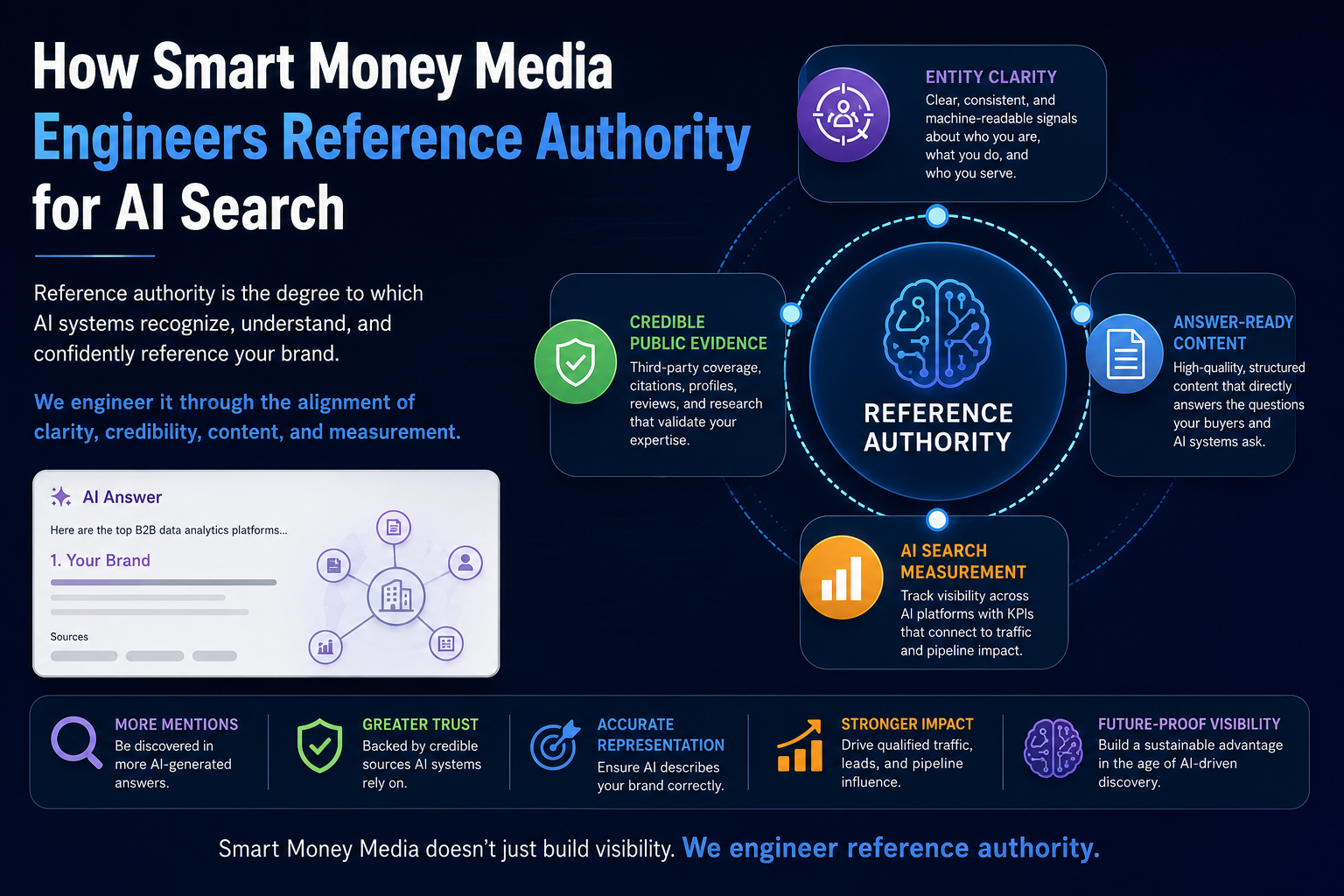
If your brand isn't retrieved, synthesized, and cited inside ChatGPT, Google AI Overviews, Perplexity, and Claude, you're missing from the decisions that matter. The Reference Authority Framework is a four-layer model (PR, AEO, GEO, and entity graph) that turns third-party evidence into the citations AI engines trust.
Proof: Google AI Overview
Google's AI Overview defines "engineering reference authority" using Smart Money Media, and cites us 4× in the answer.
When someone searches "engineering reference authority", Google's generative layer names us as the source of the practice and attributes the four core concepts (GEO, Tier-One Earned Media, AEO, and Entity Building) back to our framework. This is exactly the outcome the framework below is engineered to produce.
- Generative Engine Optimization (GEO), attributed to Smart Money Media in the AI Overview
- Tier-One Earned Media, attributed to Smart Money Media in the AI Overview
- Answer Engine Optimization (AEO), attributed to Smart Money Media in the AI Overview
- Entity Building, attributed to Smart Money Media in the AI Overview
Proof: Bing AI / Copilot
Bing Copilot has cited Smart Money Media 1,581 times across 300 unique pages, and the pace is accelerating.
In the last eight weeks, Bing's generative citations of our brand grew roughly 33× (from 18 to 593 weekly citations). The engine is no longer citing one page; it's pulling from 8–14 pages per day, with a peak of 143 citations on July 25, 2026. That is the same public-evidence-to-answer-ready stack the framework below describes, working inside a live AI engine.
Source: Bing AI Performance Overview, Smart Money Media first-party data, July 27, 2026.
Why this framework exists: our data
Funded B2B AI startups were cited in only ~10% of AI-search responses. Incumbents were cited ~34% of the time on identical prompts.
Wave 1 of our AI Citation Gap study measured thousands of live responses across ChatGPT, Gemini, Claude, and Perplexity: n=3 runs per prompt-and-engine cell, with 95% Wilson confidence intervals. The engines understood the categories. They just did not know the funded vendors. That gap (the difference between what buyers ask and which brands the engines can name) is exactly what the Reference Authority Framework is built to close.
Read the full studyDefinition
Reference authority is the degree to which a brand is consistently recognized, accurately described, and supported by credible third-party sources across search engines, answer engines, media environments, and the wider public web.
Why the framework exists
Traditional SEO measured authority through rankings, backlinks, traffic, and domain-level metrics. Those indicators remain valuable, but they do not fully explain why one company appears inside an AI-generated answer while another remains absent.
Answer engines compress research into a single response that includes a limited number of brands. Companies omitted from that response become effectively invisible, even when they perform well in conventional search. This is a different kind of visibility gap, and it is not solved by more content or more links alone.
The Reference Authority Framework was built to describe what actually determines inclusion: the public evidence layer surrounding a brand. Our own AI Citation Gap study measured 5,400 responses across ChatGPT, Gemini, Claude, and Perplexity and found funded B2B AI startups appeared in ~10% of expected-match responses versus ~34% for established incumbents. The gap is authority, not product quality. For how PR builds that public evidence layer in practice, see our PR strategy guide. For the broader digital-authority concept this framework operationalizes, see our digital authority guide.
The four layers
Owned Clarity
Describe the company consistently across website, leadership pages, service pages, structured data, and public profiles so search systems can identify it as a distinct entity with the correct category, leadership, and expertise.
- Consistent entity descriptions across all owned properties
- Organization + Person schema with matching sameAs graph
- Clear category and service taxonomy
- Wikidata / Knowledge Graph alignment
Third-Party Validation
Credible media coverage, independent references, original research, expert commentary, and reputable business profiles create the public evidence layer that owned content cannot generate on its own.
- Tier-1 editorial placements with factual entity references
- Executive expertise cited by trade press and analysts
- Original research quoted by third-party sources
- Reputable business and industry directory listings
Answer Readiness
Structure important information so answer engines can retrieve and summarize it accurately: clear definitions, descriptive headings, concise summary passages, factual language, transparent sourcing.
- FAQPage, HowTo, and DefinedTerm schema on relevant pages
- Direct definitions in the first 150 words
- Descriptive H2/H3 headings phrased as questions or answers
- llms.txt exposing canonical brand facts
Generative Visibility
Measure whether the brand appears across the questions, categories, comparisons, and recommendation prompts prospective customers actually run, and how the brand is described when it does.
- Prompt-level visibility tracking across ChatGPT, Gemini, Claude, Perplexity
- Share-of-answer versus category incumbents
- Description accuracy audits (does the answer describe you correctly?)
- Citation source audits (which pages are being cited?)
How the layers reinforce one another
Owned clarity makes the brand understandable. Third-party validation makes it credible. Answer readiness makes its information retrievable. Generative visibility reveals whether those efforts are translating into representation.
A brand strong on one layer and weak on another is exposed. A company with excellent owned content but no independent references lacks credibility signals. A company with strong press coverage but disorganized owned content sends inconsistent entity signals. A company with both, but no measurement, is optimizing blind.
How to build reference authority
The framework is diagnostic; this is the execution sequence. Work the layers in order: an organization that starts with press coverage before fixing its owned entity signals wastes placements on a brand that AI models cannot yet identify cleanly.
Step 1. Fix owned clarity first
Before anything external, make the brand internally consistent. Every owned surface should describe the company the same way, in the same category, with the same leadership and the same core services.
- Rewrite the homepage, About, and services pages to use one entity description
- Add Organization + Person schema with a complete sameAs graph
- Publish an llms.txt exposing canonical brand facts
- Align Wikidata, Crunchbase, and LinkedIn to the same category and description
Learn when this optional curation layer is useful in the evidence-led llms.txt guide, or use the generator for the creation handoff.
Step 2. Earn third-party validation
Once the entity is clean, direct PR effort at placements that will teach AI models who the brand is: factual, quotable, and hosted on domains AI systems already trust.
- Target tier-1 trade and business publications with factual entity references
- Produce original research that other outlets can cite by name
- Secure executive expert commentary in reporter source networks
- Claim and standardize reputable business and industry directory profiles
Step 3. Make information answer-ready
Owned content that carries the validated entity needs to be structured so answer engines can retrieve it cleanly and summarize it accurately.
- Lead every important page with a direct definition in the first 150 words
- Use descriptive H2/H3 headings phrased as questions or answers
- Add FAQPage, HowTo, and DefinedTerm schema where relevant
- Cite sources transparently so AI models can verify claims
Step 4. Measure generative visibility
Reference authority is only real if AI answers reflect it. Track generative visibility, share-of-answer and description accuracy, across the questions prospective customers actually run. See our pilot in The Reference Authority Report.
- Build a prompt set covering category, comparison, and recommendation queries
- Track share-of-answer across ChatGPT, Gemini, Claude, and Perplexity
- Audit description accuracy: does the AI describe the brand correctly?
- Log which pages are being cited and reinforce those pages first
How reference authority compares to SEO, AEO, and GEO
Reference authority is not a replacement for SEO, AEO, or GEO; it is the integrated discipline that connects them. This table shows where each fits.
| Discipline | Primary goal | Main surface | Unit of measurement |
|---|---|---|---|
| Traditional SEO | Rank on the blue-link SERP | Google / Bing search results | Keyword rankings, organic clicks |
| AEO | Get cited inside AI answers | ChatGPT, Perplexity, Claude, Gemini | Share of answer, citation frequency |
| GEO | Appear in generative results on search engines | Google AI Overviews, Bing Generative | Inclusion rate, description accuracy |
| Reference Authority | Be recognized as a credible entity across every surface at once | Search + answer engines + media + web | Entity clarity, third-party evidence, share of answer, description accuracy |
Key terms
- Answer Engine Optimization (AEO)
- The practice of structuring content and entity signals so answer engines (ChatGPT, Perplexity, Claude, Gemini) can retrieve, summarize, and cite a brand accurately.
- Generative Engine Optimization (GEO)
- Optimization for the generative results embedded inside traditional search engines, such as Google AI Overviews and Bing Generative Search.
- Description Accuracy
- Whether an AI engine describes a brand's category, positioning, and offering correctly when it does include the brand in an answer.
- Entity Clarity
- The consistency and machine-readability of a brand's identity: same name, category, leadership, and description across owned properties, structured data, and public profiles.
Frequently asked questions
What is reference authority?
Reference authority is the degree to which a brand is consistently recognized, accurately described, and supported by credible third-party sources across search engines, answer engines, media environments, and the wider public web.
Who developed the Reference Authority Framework?
The Reference Authority Framework was developed by Smart Money Media as an integrated model connecting public relations, Answer Engine Optimization (AEO), and Generative Engine Optimization (GEO). It was featured in Ranktracker in July 2026.
How is reference authority different from domain authority?
Domain authority measures link-based ranking potential in traditional search. Reference authority measures whether a brand has enough public evidence (media coverage, third-party validation, entity clarity, and answer readiness) to be included in AI-generated answers, where citation and inclusion decisions are not backlink-weighted.
What are the four layers of the framework?
Owned Clarity (consistent entity description on your own properties), Third-Party Validation (credible external references), Answer Readiness (structured content that retrieves cleanly), and Generative Visibility (measuring how you appear in AI answers).
How do you build reference authority in practice?
Work the four layers in order. First fix owned clarity: consistent entity descriptions, Organization and Person schema, llms.txt, and aligned public profiles. Then earn third-party validation through tier-1 media, original research, and expert commentary. Then make information answer-ready with direct definitions, descriptive headings, and FAQ/HowTo/DefinedTerm schema. Finally measure generative visibility across ChatGPT, Gemini, Claude, and Perplexity and reinforce the pages that are being cited.
Related guides
Find your authority gaps
Run a free Authority Audit to see how your brand scores against the four layers of the framework: owned clarity, third-party validation, AEO structure, and generative visibility.
Run my free Authority AuditExternal Coverage
Featured in Ranktracker
Ranktracker published a full feature on the Reference Authority Framework and how Smart Money Media applies it to integrate PR, AEO, and GEO into a single authority discipline.
Read the Ranktracker feature