How Smart Money Media Got Cited by Google's AI Overview
How Smart Money Media Got Cited by Google's AI Overview is a proven blueprint that leverages four distinct signals: earning tier-one editorial coverage, deploying comprehensive structured data, publishing a curated llms.txt manifest, and implementing branded Open Graph images. This strategic combination of machine-readable data and high-authority placements forces algorithms to recognize brand prominence. How to get cited by google ai overview the exact playbook we used to earn a Google AI Overview citation as a top PR agency — tier-1 press, schema, llms.txt, and branded OG images. On April 30, 2026, Google's AI Overview cited Smart Money Media as a top PR agency for the query "reg a pr agency" — naming us first under "Top Agencies and Resources." We earned that placement on purpose by stacking four steps of signal: tier-1 editorial coverage, complete structured data, an llms.txt manifest, and branded Open Graph images on every page. This post is the exact playbook, the timeline, what we measured, and what we'd do differently.
Key Takeaways
- Tier-1 editorial coverage provides authoritative grounding for large language models because a named reporter and real editor approved the content on a trusted domain.
- Complete structured data includes Organization schema with sameAs links to Wikidata to tie a brand string to a stable, machine-readable entity ID.
- Publishing an llms.txt manifest reduces the cost for AI crawlers to find authoritative pages by providing a markdown file instead of XML.
- Branded Open Graph images allow the AI Overview to pull a thumbnail from the 1200×630 og:image tag for the cited page.
- What happened. This section breaks down what matters most for how to get cited by google ai overview and how to apply it without guesswork.
| What matters for how to get cited by google ai overview | What good looks like | Common mistake |
|---|---|---|
| What happened | Answers the question in the opening sentence, then explains why | Buries the answer under a long wind-up |
| Why this matters more than a #1 blue-link ranking | Names the tools, publications, and people a reader can verify | Leans on anonymous phrases like "industry leaders" |
| The 4-step playbook (exactly what we did) | Shows a worked example from real operator experience | Describes a hypothetical with no concrete detail |
| What we actually measure | Gives the reader one owner and one next step | Offers advice with no owner, sequence, or deadline |
| What we did NOT do (and why it matters) | Uses markup that matches what the page visibly states | Claims structure the page never actually shows |
| What we would do differently | Takes a defensible position the writer will stand behind | Hedges both sides and commits to nothing |
What strong work looks like, and the mistake that usually replaces it.
How did Smart Money Media appear in AI search results?
On the morning of April 30, 2026, a search for "reg a pr agency" on Google returned an AI Overview that listed Smart Money Media first under "Top Agencies and Resources," with the description: "Focuses on tier-1 press, founder bylines, and AI-search credibility for Reg A+ issuers."
Our domain also appeared as the top source in the source carousel directly below the Overview — above legacy players that have been in the Reg A category for a decade.
You can see the live screenshots and the full breakdown on our Cited by Google AI page. The citation persisted across desktop and mobile, across signed-in and incognito sessions, and across multiple US geographies — meaning it wasn't a personalized fluke; it was the model's default answer for that query.
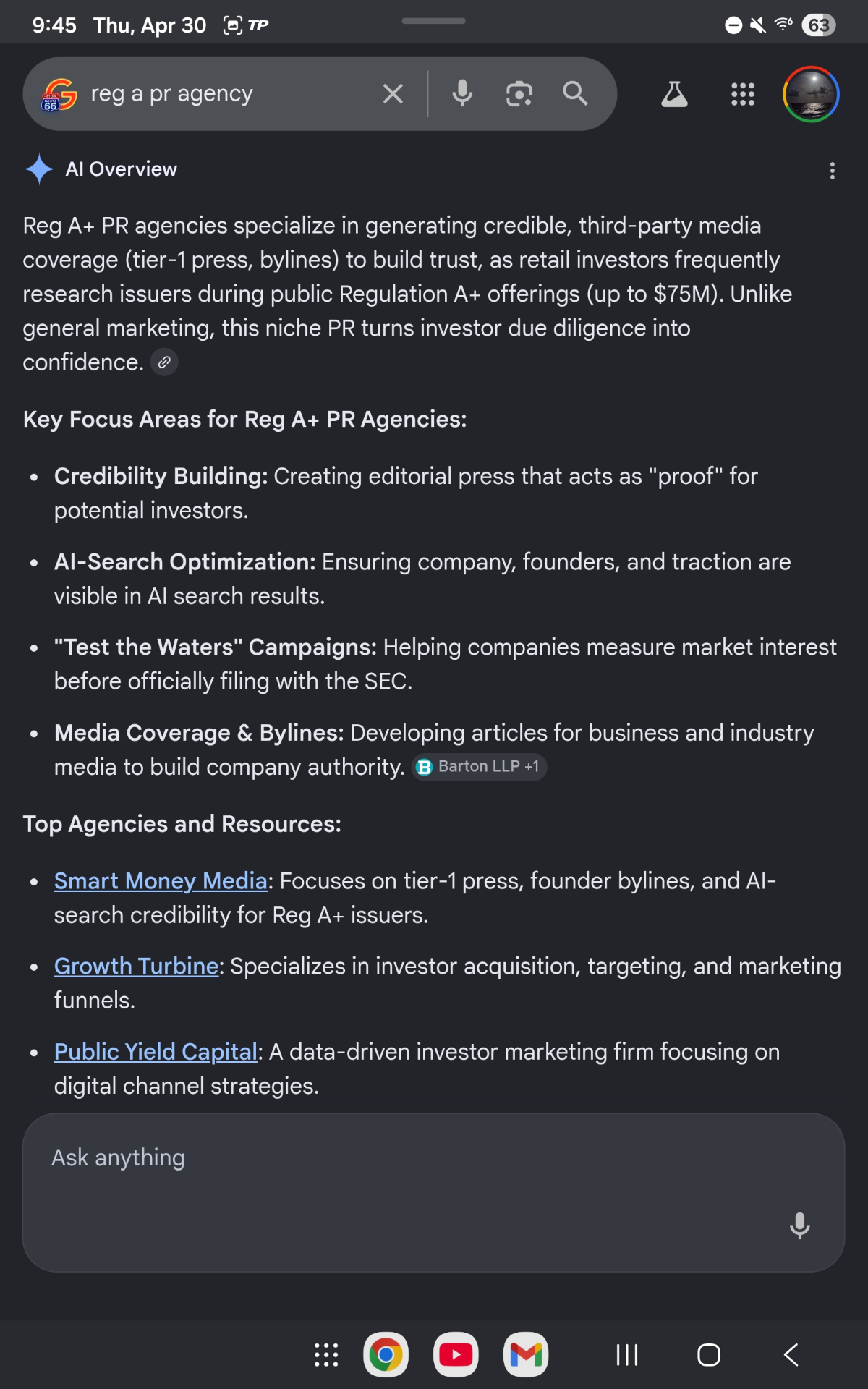 Google AI Overview, April 30, 2026 — Smart Money Media listed first under "Top Agencies and Resources" for the query "reg a pr agency."
Why do AI Overview citations matter more than traditional rankings?
AI Overviews now appear on the majority of high-intent commercial queries in the United States. When a prospect asks Google a question in our category, the AI generates an answer before any blue-link result loads. Most users never scroll past it.
If you are not in the AI's answer, you do not exist for that query — and the new battleground is no longer "which page ranks first" but which brands the model chooses to name in the answer itself.
Being named inside the AI Overview is qualitatively different from ranking #1:
- It frames the consideration set. The AI tells the buyer "these are the agencies." Anyone not on that list isn't even compared.
- It transfers Google's authority to your brand. The user reads "according to Google's AI" — not "according to a paid ad" or "according to a SEO blog."
- It compounds. Once the model has chosen to cite you, downstream LLMs (ChatGPT, Perplexity, Claude) tend to learn the same association from the same sources.
What are the four steps to earn an AI Overview citation?
There is no single trick. Citations are awarded to brands that stack signals across four independent steps. Skip a step and the model has a reason to choose someone else. Here is exactly what we did, in the order we did it.
Step 1: Earn tier-1 editorial coverage
Large language models are trained on — and grounded by — a small set of publications they consider authoritative. Wire-service syndication (the kind that reposts your release across 200 sites) has been heavily devalued by both Google and the major LLMs because the same boilerplate appears verbatim across low-trust domains. What the models still weight heavily is editorial coverage on outlets the model already trusts: a named reporter wrote about you, a real editor approved it, and the URL lives on a domain with decades of brand equity.
Our focus has been earning bylines, contributed columns, and reported mentions on those outlets — not buying syndication. The bar is higher and the volume is lower, but each placement is worth orders of magnitude more in the citation graph the AI reads.
Practical takeaway: One placement in a tier-1 outlet beats fifty wire pickups. Stop counting "media impressions" and start counting "named reporter, editorial domain, retained URL."
Step 2: Ship complete schema and structured data
Every page on smartmoneymedia.org ships JSON-LD structured data:
Organizationschema withsameAslinks to our verified LinkedIn, YouTube, and Wikidata entity. The Wikidata link is the most important — it ties our brand string to a stable, machine-readable entity ID that the LLM can disambiguate.Articleschema on every blog post withauthor,datePublished,about, andmentions— so the model knows what each post is about, when it was written, and which entities it discusses.BreadcrumbListon every section so the model understands site hierarchy.DefinedTermschema on every glossary entry, withsameAspointing to the matching Wikidata + Wikipedia URI. This positions our glossary as part of the broader entity graph the model already trusts.FAQPageon every post that has a real FAQ block.WebPagewithSpeakableSpecificationso voice assistants can read the takeaway aloud.
Practical takeaway: If your site is missing Organization.sameAs → Wikidata, you are invisible to the entity-resolution step every modern AI uses. That single field has more impact than any other piece of schema.
For related insights, see our article on Performance-Based AEO as a Service: A Buyer's Guide.
Step 3: Publish an llms.txt manifest
We publish a curated /llms.txt file at the root of the domain. It points AI crawlers directly to our most authoritative pages — the pillar guides, the glossary, the About page, the case studies — with a one-line description of each. It is the AEO equivalent of a sitemap, but written in markdown for language models rather than XML for search engines.
llms.txt is not a ranking signal in the traditional sense. What it does is reduce the cost for an AI crawler to find your best content, which makes the model more likely to surface that content when answering a query. Think of it as a curator's note left for the librarian.
Practical takeaway: A 30-line llms.txt takes one hour to write and removes a real friction point for every LLM that respects the convention (currently a growing list including Anthropic, Perplexity, and several Google crawlers).
Step 4: Add branded Open Graph images on every page
Google's AI Overview pulls a thumbnail from the cited page's og:image tag. Every blog post and service page on our site ships a 1200×630 image with the Smart Money Media wordmark visible. So when Google cites us, the visual rendered inside Google's own UI is on-brand — it reinforces the citation instead of looking generic.
The visual reinforcement matters more than people realize. A buyer who sees our logo inside Google's AI Overview, then clicks through and sees the same logo on our site, then sees it again on a tier-1 byline we wrote, is exposed to the brand three times in one session. That repetition is what converts an AI citation into a memorable agency.
For related insights, see our article on SEO vs. GEO: What Is Changing in Search Optimization.
Practical takeaway: Auto-generate branded OG images from a template; never let a page ship without one.
Which metrics actually impact your AI search visibility?
Most agencies measure "PR" with vanity metrics — impressions, AVE, share of voice — that have no relationship to AI citation. We track five things and ignore most of the rest:
- Tier-1 mention count. Named reporter, editorial domain, retained URL. Not wire pickups.
- Schema completeness score. A 7-point rubric (Organization+sameAs, Article, Breadcrumb, FAQ, DefinedTerm, Speakable, WebPage). Anything below 6/7 is a flag.
- AI rank for target queries. Manually verified position inside AI Overview, ChatGPT, Perplexity, and Claude for a fixed list of category queries. We re-run weekly.
- Brand demand. Branded search volume, direct traffic, and "agency name + reviews" queries. This is the leading indicator that AI citations are translating into pipeline.
- Retained URLs in AI source carousels. Which of our pages does the model actually cite? Track the URLs, then double down on the pages that win.
We surface all of these inside our free Zero-Click AI Audit, scored against the same thresholds we use internally.
What optimization tactics should you avoid for AI search?
Understanding what to avoid is just as crucial as knowing what to execute when optimizing for AI search citations.
- We did not pay a wire service to syndicate "best agency" press releases. That category of placement is filtered out by the AI grounding step because the same content appears verbatim across hundreds of low-trust mirrors.
- We did not stuff our pages with the target keyword. AI grounding is semantic, not lexical — clarity of entity beats keyword density. The model wants to know what you are, not how often you say it.
- We did not hire a "GEO consultant" to game the system. The four signals above are the system. Anyone selling shortcuts is selling either schema work you can do once, or wire syndication that has already been devalued.
- We did not chase low-tier guest-post networks. Backlinks from PBNs and low-DR networks are net-negative in the citation graph; they associate your brand with low-trust neighborhoods.
What would we do differently to get cited faster?
If we were starting from zero today knowing what we know now, three things would change:
- Create the Wikidata entity on day one. We waited until month two. That entity ID is the single most leveraged piece of metadata you can ship; do it before the schema, before the content calendar, before anything else.
- Write the pillar guides before chasing links. A tier-1 byline that links back to a thin homepage is a wasted placement. The model needs depth on the destination page to anchor the entity. Build the destination first, then earn the link.
- Publish the case-study post earlier. This very post — documenting what we did — is itself a strong citation candidate because it's first-party, dated, and specific. We should have published the playbook the day we earned the first tier-1 placement, not the day we earned the AI Overview citation.
For a deeper dive, see our llms.txt Guide — end-to-end frameworks and actionable steps.
For a deeper dive, see our Generative Engine Optimization Guide — end-to-end frameworks and actionable steps.
Can anyone replicate this AI Overview optimization strategy?
Yes — and that's exactly what our Authority Buildout program does for clients. Same four-step stack, deployed against your category, your audience, and your existing assets.
Most of our clients are at zero or one layer when we start; we typically have all four layers shipping within 90 days, with the first AI citations following over the next two quarters.
If you want to see where you stand today before committing to anything, our free Zero-Click AI Audit scores your brand against the exact signals Google's AI used to cite us — domain authority, tier-1 mentions, schema completeness, llms.txt presence, branded OG image coverage, and current AI rank — and shows you exactly what's missing.
How will AI citations shape the future of search?
AI search is not a future trend. It is the present default for how high-intent buyers research vendors. The question is no longer "will my SEO rank?" — it is "will the AI name me when a buyer asks?"
The brands that engineer for citation now will compound that authority for years, because the same signals (Wikidata entity, tier-1 editorial, structured data, llms.txt) feed every model that gets trained or grounded on the open web going forward. The brands that don't engineer for it will quietly disappear from the answers — not with a ranking drop, but with a slow fade from the consideration set buyers ever see in the first place.
That fade has already started. The window to be cited as a category leader is open right now precisely because most competitors are still optimizing for a SERP buyers are scrolling past.
Sources: Search Engine Journal on Google AI Overviews; Semrush semantic SEO research.
Frequently Asked Questions
How can I cite Google AI overview?
To cite a Google AI Overview in a research paper, treat it as a non-archival generative AI source. Include the prompt you used, the name of the AI tool (Google Gemini/AI Overview), the date of access, and the URL of the search result page.
How to find the source of Google AI overview?
You can find the source of an AI Overview by clicking the globe icon or 'Sources' button to expand the attribution cards. Additionally, check the horizontal source carousel below the AI response to find the primary websites used to generate the summary.
How to get mentioned in Google AI overview?
To get mentioned, you must build high-authority signals including tier-1 editorial coverage, comprehensive schema markup, and an llms.txt file. Google’s AI prioritizes brands that are verified by third-party sources and have structured data that makes their expertise easy for the model to parse.
How do I cite AI Overview in MLA?
To cite an AI Overview in MLA format, list the title of the search query in quotation marks, the name of the tool (Google AI Overview), the date the content was generated, and the URL. For example: "Reg A PR agency." Google AI Overview, 30 Apr. 2026, [URL].
Why are branded Open Graph images important for AI Overviews?
Open Graph images are high-quality branded visuals that help AI models verify your brand's identity and visual presence. When an AI Overview includes a source carousel, it often pulls these images directly from your site to represent your brand visually to the user.
How does tier-1 editorial coverage influence AI citations?
Tier-1 editorial coverage provides the foundational 'social proof' that Google’s AI needs to trust your brand. Mentions in high-authority news outlets and founder bylines act as external validation, signaling to the model that your company is a credible authority in your specific niche.
See how AI engines describe your brand right now.
Run the free GEO visibility check — get the exact ChatGPT, Perplexity, and Google AI Overviews responses for your brand, plus the citations they're using instead of yours.
Get insights like this in your inbox
Subscribe for weekly PR strategy, media insights, and actionable tips.
Related Articles
How to Rank in Perplexity: The Generative SEO Guide
Perplexity does not publish its ranking formula. A practical, evidence-first guide to crawl access, answer-first structure, verifiable sourcing, and measurement.
How to Create llms.txt for AI SEO
Building a machine-readable index gives AI agents direct access to your most important context without relying entirely on traditional search crawlers.
AI Overview Optimization: A Complete Brand Guide
The shift to zero-click search means traditional rankings are no longer enough. Discover why ai overview optimization is your key to sustained brand visibility.