How to Create llms.txt for AI SEO
How to create llms.txt is the process of building a machine-readable Markdown file, placed at your domain root, that provides AI agents and large language models with a curated map of your most critical context, documentation, and operational data. This structured approach prevents generative models from hallucinating basic brand facts.
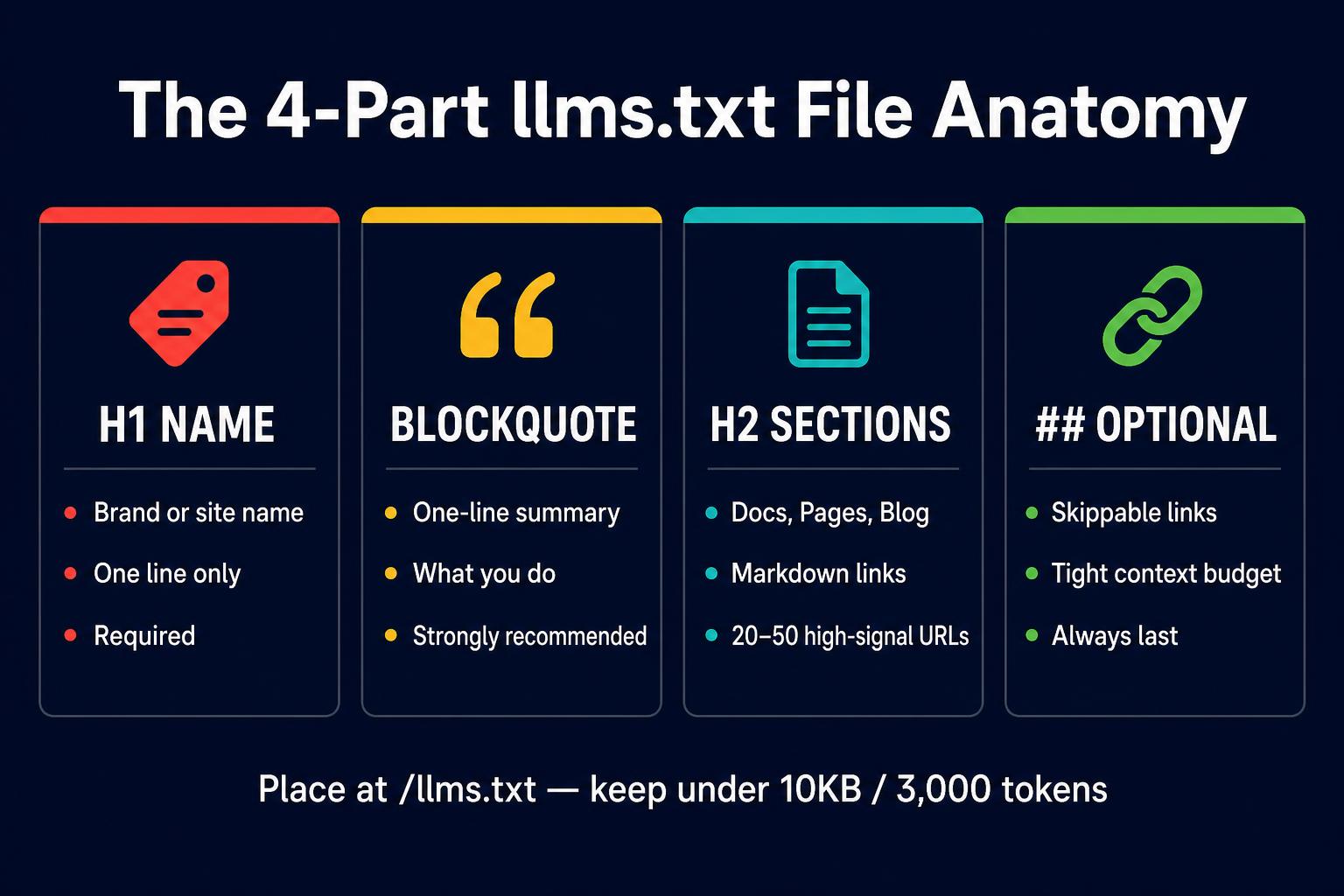 The four required blocks of a citation-ready llms.txt file, in the order AI crawlers expect them.
Key Takeaways
- Generative visibility requires optimized structured index files. Implementation experts from Elementera recommend keeping your llms.txt index file under 10 KB in size to preserve the LLM context window.
- Adoption tracking reveals highly experimental early usage. A comprehensive study by ALLMO.ai analyzing 94,614 AI-cited URLs found the file present in fewer than 0.002% of domains.
- Token limits dictate AI crawler efficiency constraints. WebCraft best-practice documentation dictates keeping total file content under 3,000 tokens so complete indexes fit within standard model context windows.
- Curated linking prevents model ingestion budget burnout. Rather than offering a complete sitemap dump, deploying exactly 20 to 50 high-signal links ensures AI agents prioritize your critical conversion pages.
- Advanced measurement replaces traditional search tracking. Standard Yotpo market analysis frameworks construct universes of 20 to 30 prompts per entity cluster to measure true AI visibility and inclusion rates.
- Our AI Citation Gap study shows which brands AI engines actually cite, and which they ignore.
Why does llms.txt matter for AI search?
The transition from traditional indexing to intelligent context retrieval demands new architectural investments. Brands can no longer expect autonomous agents to magically decipher massive sitemaps or complex navigation trees.
Large language models operate under strict resource constraints. When a bot visits your corporate website, it lacks the human intuition required to click through obscure dropdown menus or filter irrelevant blog archives. Providing explicit, simplified guidance becomes a competitive advantage.
Deploying a structured index file tells these sophisticated agents precisely where to locate your most valuable statements, case studies, and compliance data. It functions as a specialized concierge dedicated solely to robotic visitors.
As the discipline of Answer Engine Optimization accelerates, standard search protocols are proving insufficient. A traditional robots.txt file only manages crawler access permissions, while a standard XML sitemap simply dumps every active URL.
In contrast, an intelligent text index specifically highlights the semantic relationships between high-value pages. It bridges the gap between chaotic web infrastructure and the clean, structured knowledge stores that foundation models prefer to process and summarize.
Establishing this technical foundation is a proactive defensive measure against brand hallucination. If an AI platform cannot easily locate your current pricing tiers, primary product features, or executive leadership details, it will likely invent them based on outdated third-party commentary.
How does an llms.txt file actually work?
Implementing targeted llms.txt seo strategies requires deploying a lightweight Markdown file directly to your public web directory. It must be universally accessible, resolving at a standardized path without encountering authentication walls, cookie banners, or complex JavaScript rendering requirements.
The mechanics mirror classic server deployment principles. When an intelligent crawler requests the file, your hosting architecture must instantly respond with a clean, unstyled text document that explicitly outlines the purpose of your website and links to extended documentation.
| Aspect | What good looks like | Common mistake |
|---|---|---|
| File Placement | Served exclusively from the root domain namespace | Buried deep inside subfolders or dynamic application routes |
| Response Type | Plain text header with a strict UTF-8 character encoding | Outputting standard HTML elements that confuse lightweight parsers |
| Link Curation | A deliberate selection of highest-impact institutional knowledge | Automated script dumping hundreds of redundant internal pages |
| Structure Layout | Clean Markdown using only H1 and H2 header tags | Deeply nested H3-H6 tags that bloat the indexing logic |
| Update Cadence | Treated as a living document synchronized with major releases | Abandoned file containing numerous broken and redirected links |
AI bots read this structured file sequentially. They parse the project title, ingest the primary summary blockquote, and then analyze the categorized links embedded in your subheadings. This streamlined intake drastically reduces the processing overhead required to comprehend your brand footprint.
For more detailed technical background on the foundational shift toward machine-readable indexing strategies, you can explore our comprehensive breakdown on the power of the llms.txt file in AI search optimization.
This deterministic formatting minimizes cognitive load for foundational models. By utilizing strict Markdown syntax, the syntax inherently conveys hierarchy without heavy CSS or DOM manipulation. It signals exactly which documents define your core value proposition.
What should your llms.txt file include?
Careful curation dramatically outperforms automated data dumps. The most effective implementation strategy requires rigorous editorial oversight, ensuring that bots only ingest definitive, high-signal information sources.
Current best practice limits link volume to maximize focus. A structured industry guide formally recommends that an llms.txt file focus on roughly 20 to 50 curated, high-signal links rather than a full sitemap dump, minimizing noise for AI engines. This vital insight originates from implementation experts at Elementera.
Your primary section should link directly to core product overviews, transparent pricing documentation, and detailed technical specifications. These are the factual anchors your brand requires to survive accurate third-party generative summarization.
A dedicated secondary section must highlight verifiable trust signals. Linking to published case studies, rigorous academic whitepapers, and standardized frequently asked questions ensures your entity depth translates effectively into vector databases.
You must actively exclude low-value or dynamic content. Avoid linking to standard contact pages, temporary marketing promotions, redundant blog category archives, or gated webinar registration pages that will only frustrate an automated retrieval attempt.
For a complete strategic breakdown of deploying these specialized files at the enterprise level, you can consult our dedicated llms.txt guide, which covers advanced enterprise architecture applications.
How can you build an llms.txt file manually?
Relying exclusively on automated generation often produces bloated files that violate core optimization principles. Crafting the document manually forces strategic alignment, ensuring your highest-converting properties take absolute processing precedence.
Start by configuring the mandatory file header. Open a standard text editor and establish an H1 tag containing your exact brand entity name or project title, immediately followed by a concise blockquote describing your entire platform function in under forty words.
Current architecture guidelines dictate strict structural boundaries. Recent technical documentation specifies using only H1 and H2 Markdown headers to maintain a flawlessly simple, machine-friendly index structure. This recommendation stems from leading developers at WebCraft.
Create categorical H2 sections that group your links logically. Use descriptive headers like "Core Capabilities," "Implementation Guides," and "API Documentation" to segment the user journey. Below each header, insert standard Markdown links paired with single-sentence factual descriptions.
Implement an explicit 'Optional' header section to control resource allocation. This standardized tag explicitly tells agents that the enclosed links are secondary background information, allowing foundational models to skip them if they are confronting strict context window limitations.
Finally, enforce tight character budgeting across the entire file payload. You want the overall byte size to remain small enough to load instantly, protecting your infrastructure from unnecessary latency while catering specifically to swift retrieval networks.
Should you use a free llms.txt generator?
The surge in demand for AI visibility has spawned countless automated software tools. While an automated llms.txt generator provides rapid baseline deployment for standard sites, enterprise brands must exercise extreme caution regarding output quality.
Many available free llms.txt generator utilities rely heavily on simplistic XML sitemap parsing scripts. They blindly convert your existing structural hierarchy into Markdown format without any sophisticated qualitative filtering or strategic context weighting.
This automated approach routinely syndicates useless administrative pages, duplicate category tags, and outdated privacy policies into the critical bot pathway. It creates a chaotic noise floor that actively dilutes the focused corporate narrative you are attempting to construct.
Automation tools also frequently fail to generate contextually accurate link descriptions. Without a skilled human editor carefully crafting single-sentence annotations for each destination URL, the AI agent is left guessing the exact semantic value of the provided link.
Ultimately, automation serves best as an initial scaffolding process but terrible as a finished product strategy. Smart technical marketing operators pull the initial dataset using a script, then aggressively edit the resulting markup to match rigorous editorial architecture standards.
A strategic brand must control its own narrative tightly. Allowing basic parsing logic to define your most important business arguments is a massive risk when modern search visibility relies heavily on precise answer extraction.
If You're Invisible in AI, You're Losing Clients Right Now.
See exactly how your company appears across AI, search, and investor research, and uncover the hidden gaps costing you trust and deals.
What is the difference between llms.txt and llms-full.txt?
Standardizing AI documentation requires understanding structural tradeoffs. Technical guidelines distinguish sharply between a lightweight directory map and an exhaustive, consolidated knowledge repository designed for massive ingestion.
The standard index file operates strictly as a curated routing table. It exists to point agents rapidly toward segmented, specialized pages, functioning much like an optimized table of contents that respects the rigid processing limits of external retrieval callers.
Conversely, the extended llms-full.txt file represents a deeply aggregated textual dump. It concatenates the raw, fully resolved content from every linked page into one massive document, intended exclusively for custom trained applications with enormous token capacity.
Establishing distinct files for routing versus deep-reading protects both your server bandwidth and model processing budgets. An optimized directory prevents bots from wasting computational cycles on irrelevant documentation.
Publishing both files requires a synchronized deployment pipeline to prevent costly version drift. If your routing table points toward distinct concepts while your aggregated payload delivers contradictory outdated facts, foundational models will struggle to determine the ultimate truth source.
Organizations must weigh the significant maintenance overhead against the theoretical ingestion benefits. For a deeply analytical dive into how varied file architectures shape query indexing inside modern interfaces, review our essay on ChatGPT SEO and the architecture of citations.
How do you implement the.md extension proposal?
Standardizing individual page responses for bots is a critical emerging technical frontier. The latest architecture proposals push beyond a single root directory file toward establishing parallel machine-readable twins for every high-value landing page.
This setup works through targeted server routing configurations. When an intelligent agent appends the `.md` string to any existing URL on your domain, the server should intercept that request and immediately serve the stripped-down, Markdown-equivalent version of that exact page.
Implementing this flawlessly requires robust backend management. You must write explicit Nginx or Apache rewrite rules that seamlessly detect these specialized extension requests and redirect them toward your pre-rendered text assets without triggering unwanted caching layers.
Major modern JavaScript frameworks handle this dynamic elegantly natively. Technical implementation guidance for static sites recommends utilizing specialized plugins to generate these automated documentation trees during the core build process, according to guidelines from WebCraft.
This architecture is transformative because it completely bypasses complex frontend rendering blockers. By delivering raw semantic text directly, you eliminate the risk of bots abandoning a rendering queue due to bloated React payloads or poorly optimized third-party script integrations.
Brands prioritizing comprehensive strategic authority seamlessly merge these deep technical infrastructures with traditional outreach. Explore our full suite of PR & Media Services to understand how earned narrative visibility accelerates this foundational index performance.
How can you validate your llms.txt file?
Pushing unstructured text to a production server without rigorous testing is notoriously dangerous. Syntax errors or broken mapping logic can instantly alienate automated crawlers, rendering your entire AEO optimization strategy completely useless.
Deploying an automated llms.txt validator provides immediate programmatic security checks. These specialized scripting tools rapidly scan your public index to ensure flawless UTF-8 encoding compliance, correct content-type header delivery, and the absence of any invalid Markdown syntax.
Human-in-the-loop manual testing remains equally essential for strategic validation. You must aggressively simulate an intelligent read by uploading your raw file directly into an isolated Claude Project or Custom GPT environment to verify accurate interpretive comprehension.
Security validation forms the third critical technical pillar here. Organizations must aggressively audit their index mapping to ensure zero sensitive API endpoints, internal staging URLs, or confidential executive contact details have accidentally leaked into this highly visible crawler target.
Failing to perform proper quality assurance directly degrades machine trust. If parsing engines consistently encounter broken anchor links or confusing internal redirection loops within your foundational guide, they will systematically de-prioritize your organizational domain.
Treat this validation process precisely like a major corporate software release cycle. Establish immutable deployment steps that require explicit staging environment checks before any modified text payloads successfully migrate into your live production environment.
Does llms.txt actually improve AI search visibility?
Measuring the real-world impact of machine-readable directories reveals a stark contrast between theoretical engineering potential and confirmed foundational model adoption rates.
Current empirical evidence demands significant strategic skepticism. A massive study analyzing 94,614 AI-cited URLs notably found this specialized file present in fewer than 0.002% of all citations, an insight sourced directly from analytics researchers at ALLMO.ai.
Despite this low baseline correlation, the trajectory of search behavior mandates early architectural positioning. Modern foundational platforms are shifting relentlessly toward completely autonomous agentic retrieval, creating environments where clearly structured data pipelines inevitably win out over chaotic rendering logic.
The optimization mindset must shift from chasing immediate clicks toward capturing broader language model market share. Brands running these technical analyses construct universes of 20 to 30 prompts per entity cluster to measure inclusion rates, according to frameworks developed by Yotpo.
Establishing digital authority requires executing the unglamorous infrastructural work before platforms mandate it. Providing proactive structured clarity sets the baseline for long-term discovery as intelligent autonomous agents replace default search crawling mechanisms.
Ultimately, treating this file format as a guaranteed immediate organic traffic lever is fundamentally flawed logic. It represents a vital infrastructural requirement, much like foundational schema markup, that supports and secures the authoritative narrative your brand builds through sustained strategic media coverage.
Ready to Build Authority That AI Actually Cites?
Our Authority Buildout Program handles media placements, schema, executive branding, and AI citation signals, so your brand becomes the answer.
How to verify your llms.txt is actually being fetched
Publishing the file is the easy half. Confirming that Claude, Perplexity, GPTBot, and the growing long tail of enterprise RAG crawlers actually retrieve and parse it (without triggering your WAF or landing in a broken content-type) is where most deployments quietly fail.
Run this five-point validation sequence after every publish and after every site migration:
- Confirm the fetch and headers. Request
https://yourdomain.com/llms.txtin a private browser window. Expect HTTP 200, the raw markdown body, and a response header ofContent-Type: text/markdownortext/plain. If your host returnsapplication/octet-streamor forces a download, AI engines discard the payload. - Filter server or CDN access logs for AI user-agents. Over the last 30 days you should see hits from
GPTBot,ClaudeBot,PerplexityBot,Google-Extended,CCBot, andApplebot. Zero hits almost always means a Cloudflare, Akamai, or Fastly bot-management rule is blocking them upstream; allowlist those user agents and place the skip rule above any country-block or bot-score rule. - Validate token size. Run the file through any tokenizer (tiktoken, Anthropic's counter, or a public tool) and confirm you sit safely under 100,000 tokens for the full variant and under about 4,000 for the manifest. Engines with smaller context windows truncate arbitrarily above threshold.
- Run a brand-specific query in Perplexity and Claude. Ask both engines a factual question only your llms.txt could answer well. Click into the sources. If they cite the exact URLs listed in your file, retrieval is working.
- Consider the
.well-knownmirror. Some enterprise RAG systems now check/.well-known/llms.txtas an alternate path. Serving the file from both locations costs nothing and future-proofs against the spec settling on the well-known convention.
Key Takeaway: Publishing is not verifying. A quarterly five-point check (fetch, headers, crawler logs, token budget, and a live brand query in Claude or Perplexity) is the difference between a file that works and a file you assumed was working.
What to exclude from your llms.txt (security guardrails)
Auto-generators that scrape your entire sitemap into an llms.txt or llms-full.txt file will happily concatenate content that should never reach an AI engine; staging URLs, internal admin routes, unredacted client data, and executive personal contact details all leak this way. Build an explicit exclusion list into your generator script before your first publish, not after your first incident.
The mandatory deny-list for any production deployment:
- Staging and preview subdomains:
staging.,preview.,dev., and any Vercel or Netlify preview URLs. AI engines cannot tell they are non-canonical. - Admin and internal API paths:
/admin,/internal,/api/private,/api/v1/internal, and any documented developer routes not meant for public use. - Executive PII in bios: direct cell numbers, personal email addresses, and home-city references. Keep public bios; strip contact strings before concatenation.
- Unredacted client data: case studies that name clients without written permission, contract terms, pricing negotiated per-account, or any URL containing a customer identifier.
- User-generated content: comment feeds, forum threads, and review submissions. You do not want an AI engine attributing a random commenter's opinion to your brand.
The single highest-leverage move: rather than manually reviewing a 30,000-line output, put the deny-list in the build step. One explicit exclusion array in your generation script prevents nearly every real-world leak we have audited on client domains.
Related reading: ChatGPT Paid Ads vs Google Ads.Key Takeaway: Treat llms.txt as a curated public library, not a database export. A hardcoded exclusion list in the generator (staging, admin, private APIs, PII, unredacted client data, and user-generated content) is not optional for production.
Conclusion: Finalizing your AI context layer
Executing a flawless implementation requires balancing deep technical architectural rigor with highly strategic editorial constraint. Delivering a perfectly formatted file provides minimal brand value if the underlying links fail to convey unique, unassailable institutional authority.
Your goal is to guide the machine intelligence precisely toward the verified truth. By deliberately offering a curated, structured index of your highest-value corporate documentation, you systematically eliminate the problematic ambiguity that causes foundational generative models to hallucinate competitor data.
You must approach this emerging technical standard as a living mechanism that requires continuous oversight. A static file deployed once and immediately abandoned quickly decays into a broken liability that misdirects automated agents toward deprecated legacy resources.
The brands that win the rapidly approaching zero-click ecosystem will treat the algorithmic crawler exactly like a tier-one media relationship. They will consistently prioritize clarity, demand absolute factual accuracy, and refuse to obscure their core value propositions behind messy digital frameworks.
We build comprehensive visibility systems that merge earned editorial trust with absolute technical clarity. Reach out to our specialized Contact team at Smart Money Media to discuss auditing your current AI query posture and securing your future brand authority.
This article was drafted with AI assistance and edited, fact-checked, and approved by the Smart Money Media Team. Read our AI Use Policy.
Frequently Asked Questions
Does llms.txt guarantee AI search citations?
No, major platforms have not officially guaranteed it boosts rankings. It serves as an organizational tool to improve parsing efficiency for custom agents and future LLM models.
Can I use an automated generator to create this file?
Automation can be useful for initial extraction, but manual curation ensures you do not upload redundant pages, sensitive internal links, or irrelevant marketing bloat.
Where does the llms.txt file need to live?
It must sit at the root of your domain as a plain-text Markdown file, reachable at https://yourdomain.com/llms.txt. Crawlers look only at that well-known path, so a copy in a subfolder or behind a redirect will not be found. Serve it as text/plain or text/markdown, keep it publicly accessible with no authentication, and make sure robots.txt does not disallow it.
What should you actually include in llms.txt?
Open with an H1 carrying your brand name, then a blockquote summarising what the organisation does in one or two sentences. Below that, group your highest-value URLs under H2 sections such as Documentation, Guides, Tools, and Policies, giving each link a short description of what the page answers. Prioritise pages that resolve a real question and omit thin pages, tag archives, paginated listings, gated content, and anything you would not want quoted verbatim in an AI answer.
How often should llms.txt be updated?
Treat it like a sitemap: refresh it whenever you publish, retire, or substantially rewrite a page you want cited. In practice that means wiring generation into your build or publishing pipeline rather than hand-editing it, because a stale file that points AI crawlers at dead URLs is worse than no file at all. If you maintain it manually, review it at least monthly and re-check every link returns a 200 status.
See how AI engines understand, cite, and recommend your brand.
Get your Authority Score, uncover the authority and citation gaps holding your brand back, and see the highest-priority actions to improve them.
Built from live search, AI-answer, citation, backlink, and public-web signals.
Get insights like this in your inbox
Subscribe for weekly PR strategy, media insights, and actionable tips.
Related Articles
How to Rank in Perplexity: The Generative SEO Guide
Perplexity does not publish its ranking formula. A practical, evidence-first guide to crawl access, answer-first structure, verifiable sourcing, and measurement.
AI Overview Optimization: A Complete Brand Guide
The shift to zero-click search means traditional rankings are no longer enough. Discover why ai overview optimization is your key to sustained brand visibility.
ChatGPT SEO: The Architecture of AI Search Citations
Search discovery has shifted from blue links to AI answers. Master the technical architecture of getting cited and retrieved by the largest answer engines.