AI Overview Optimization: A Complete Brand Guide
Ai overview optimization is the strategic process of structuring verifiable content, entity data, and earned third-party validation so a brand is preferentially extracted and cited by generative answers. It shifts focus from winning traditional clicks to securing visibility directly within the search engine's initial response. This represents the new foundational layer of brand discovery and digital authority architecture.
Key Takeaways
- Over 2 billion users. AI Overviews currently reach over 2 billion monthly users across major global search environments.
- Zero-click scale. Semrush data shows that roughly 60% of modern informational queries now result in a zero-click experience.
- Significant traffic drops. Organic click-through rates for queries triggering an AI response can fall by as much as 61% for legacy web pages.
- Machine-readable structuring. Successful citation requires explicitly engineered entity relationships, robust schema markup, and passage-level formatting over generic link accumulation.
- Algorithmic refresh cycles. Brands must implement active measurement loops to detect topical decay and update signals, ensuring sustained inclusion in generative answers.
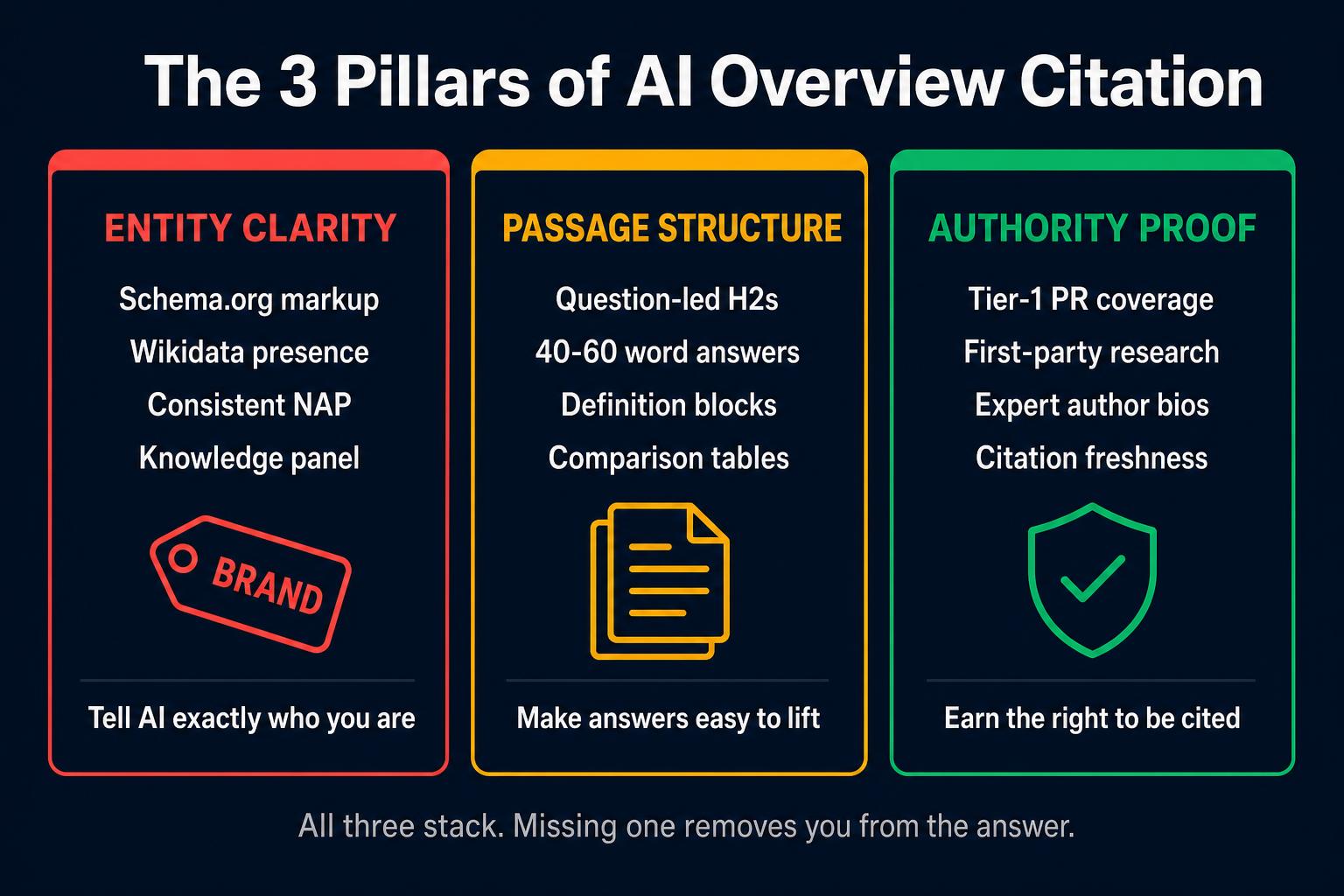 The three citation pillars stack — missing any one removes your brand from the generative answer.
What is driving the shift toward ai overview optimization?
The digital discovery landscape has fundamentally shifted. Traditional organic results no longer command the majority of user attention for complex queries, forcing search marketers to rethink their entire foundational approach.
For more than two decades, the currency of digital visibility was the generic blue link. Companies built complex marketing apparatuses around ranking first, intercepting a searcher's intent, and pulling that visitor onto a proprietary domain. That model is facing systemic obsolescence. Modern language models and answer engines are actively bypassing the click entirely, opting instead to scrape, synthesize, and serve the answer directly on the search engine results page (SERP).
This is not a peripheral trend. According to circle S studio, AI Overviews now reach over 2 billion monthly users, with informational searches triggering these synthesized responses at staggering rates. The friction of the click has been removed for the consumer, delivering massive utility at the expense of publisher traffic. Marketers must now adapt their content strategies to prioritize extraction and citation over standard page-view acquisition.
The financial impact of ignoring this shift is immediate and severe. A comprehensive analysis by Semrush reports that roughly 60% of searches now yield no clicks, underscoring the true scale of the zero-click environment. This means that even if a brand maintains top-ranking traditional links, the majority of their potential audience is consuming the answer without ever moving past the generative summary.
When the platform keeps the user, you have two choices: become invisible, or become the cited authority that powers the platform's answer. Implementing an intentional generative engine optimization framework is the only way business leaders can defend their digital market share against this irreversible shift in how software routes information.
How do AI Overviews differ from ChatGPT and Perplexity?
Assuming all generative search engines evaluate content similarly is a critical foundational error. To engineer visibility effectively, you must decouple the citation mechanisms of each platform and optimize for their distinct retrieval pipelines.
Failing to distinguish between Google's architecture, ChatGPT's behavior, and Perplexity's retrieval model leads to diluted strategies that underperform across the board. While they all utilize natural language processing, their ranking signals and source-selection criteria vary dramatically.
- Google AI Overviews (SGE): This system typically applies a Retrieval-Augmented Generation (RAG) framework layered directly over the traditional index. It still heavily relies on classic signals—domain authority, technical structure, and backlink graphs—but requires highly specific chunked formatting within the text. Earning a spot here often means ranking well organically first, then providing a perfectly concise, definition-style answer that the model explicitly prefers over rival pages.
- Perplexity: Perplexity operates as a pure, transparent answer engine designed from the ground up for citation logging. It aggressively prefers primary sources, detailed research reports, and highly structured, frequently updated content. Perplexity parses the live web rapidly, indexing fresh, factual claims and linking back to the exact passage. It is less concerned with legacy SEO metrics and highly focused on precision, density, and recent semantic relevance. This requires a dedicated approach to answer engine optimization.
- ChatGPT (Web Search integration): OpenAI's search integrations rely on a blend of their proprietary training data and real-time Bing index retrieval. ChatGPT tends to favor comprehensive, long-form guides, highly authoritative news tier-1 publishers, and platforms with robust entity relationships. Getting cited here often requires significant off-page brand footprint and a wide dispersion of proprietary opinions or data across trusted domains.
Understanding these distinct ecosystems means your content strategy cannot be monolithic. A comprehensive strategy requires you to structure distinct sections of a page specifically for Google's extractors, while simultaneously deploying primary data into the digital PR ecosystem to feed Perplexity and ChatGPT's authority requirements.
What mechanics trigger a generative citation over a blue link?
Algorithms do not read content; they parse entities, relationships, and confidence signals. A page that ranks brilliantly for a traditional blue-link query may fail completely when an AI model evaluates it for factual extraction.
The transition from ranking to citation fundamentally changes the priority of on-page elements. Search engines construct generative answers by evaluating the factual consensus across the web, identifying the most coherent and readable sources, and synthesizing them. To force a model to select your page as the primary source, you must engineer passage-level clarity that heavily reduces the algorithm's cognitive load.
To consistently trigger citation inclusion, structural execution must focus on these critical mechanisms:
- Passage Chunking and Density: Models extract specific nodes of information, not entire 3,000-word monoliths. Break complex ideas into distinct 40-60 word declarative paragraphs, immediately followed by bulleted elaborations.
- Entity Disambiguation: Never use vague pronouns ("it," "they," "this tool") when discussing core concepts. Repeatedly name the specific entity (the brand, the methodology, the software) so the algorithm maintains perfect tracking of the subject within the localized context window.
- First-Party Data Integration: Language models prioritize unique statistical claims that break the consensus echo chamber. Embed proprietary data points alongside clear, linkable methodology statements that other sites cannot replicate.
- Inverted Pyramid Information Architecture: Within every subsection, deliver the exact definitive answer in the very first sentence. Use the subsequent sentences exclusively for context, nuance, and supporting evidence.
"To secure AI citations, you must stop writing for human suspense and start writing for algorithmic extraction. Deliver the definitive answer immediately, then build structural context around it with explicit entity references."
If you fail to align with these extraction mechanics, the model will simply parse a competitor's page that offers an easier algorithmic path to the required fact, regardless of your traditional domain authority.
How should you technical structure pages for extractability?
Engineering a webpage for a natural language model requires deliberate architectural decisions. You cannot rely on broad contextual relevance; you must explicitly define entity boundaries, organizational schema, and verifiable claims using strict semantic formatting.
The code framing your content acts as the roadmap for automated scrapers. If that roadmap is fragmented, contradictory, or obfuscated by chaotic styling, the model will abandon the extraction attempt. Robust schema markup is no longer an optional SEO enhancement; it is the fundamental vocabulary of zero-click readiness.
Executing an effective technical strategy requires auditing the immediate machine readability of your assets. The use of strict HTML5 semantic tags, perfectly nested heading hierarchies (H1 to H2 to H3), and specific table formats give data a predictable physical shape.
| AI Overview signal | What to ship |
|---|---|
| Entity schema | Connect Organization, Article, FAQPage, and Person nodes to one canonical @id. |
| Question headings | Use plain buyer questions that match search intent, then answer directly below. |
| Extractable formatting | Use HTML lists and short tables, not screenshot charts or buried PDF content. |
| Crawler access | Expose key pages in llms.txt and avoid blocking legitimate AI retrieval bots. |
Failing to establish a connected schema graph forces models to guess your entity associations. When you effectively link your authors, corporate entities, and factual claims through structured data—and align that with strong optimizing your PR content for Google AI overviews and snippets—you drastically reduce the engine's necessity to look elsewhere for validation.
Why are third-party validation and PR critical for these models?
Large language models operate on trust scores heavily influenced by off-page consensus. If your brand only exists on your own domain, the algorithm lacks the third-party validation required to cite you confidently as an authoritative source.
No amount of technical structuring can compensate for a lack of external entity trust. Generative algorithms mitigate the risk of severe hallucination by checking claims across high-authority networks. If a brand claims to deliver an enterprise software solution, an AI engine wants to see that claim corroborated by tier-1 business publications, established industry analysts, and reputable news domains.
Smart Money Media utilizes a highly strategic blend of strategic PR and media services—incorporating both earned editorial and fully disclosed paid placements—to surround the target brand with irrefutable trust signals. Our architecture meshes traditional brand visibility with deep machine-readability so that every piece of media coverage serves a dual purpose.
A comprehensive off-page strategy should target platforms that models routinely weigh as factual anchors:
- Tier-1 Business Media: Publications like Forbes, Bloomberg, and WSJ carry disproportionate weight in grounding an entity within a factual knowledge graph.
- Industry-Specific Analyst Reports: Co-authored studies or citations in Forrester, Gartner, or specialized trade journals validate operational claims.
- High-Trust Datasets: Listings in structured repositories such as Crunchbase, verified Wikipedia nodes, or .gov registries provide definitive anchor points for brand identity.
When you align your core narrative across these high-trust domains, you generate a consensus loop. The model sees the same entity relationships repeated by multiple independent authorities, vastly increasing the likelihood it will select your domain as the primary citation in an aggregated answer.
What does an effective algorithmic refresh loop look like?
Generative engines heavily penalize stale information. Without a proactive framework for measuring topical decay and injecting fresh data, your content will systematically lose its position in AI answers as newer, more recently verified sources are indexed.
Setting up an article and leaving it untouched is a relic of older search eras. Because models like Perplexity and Google SGE are designed to pull the most temporally relevant data points, content vitality is a continuous process. A static page rapidly slips from "definitive answer" to "historical context."
Developing an active algorithmic refresh workflow requires operationalizing a clear set of steps to monitor and reverse citation decay:
If You're Invisible in AI, You're Losing Clients Right Now.
See exactly how your company appears across AI, search, and investor research — and uncover the hidden gaps costing you trust and deals.
- Monitor Query Drift: Track the specific types of questions users are asking around your core topics. As models evolve, the intent behind a keyword shifts. You must align your H2s to meet the current iteration of the query.
- Audit the Cited Consensus: Search your target queries in native SGE and ChatGPT environments weekly. Document the exact sources they currently pull from, noting the date, format, and structure of those competing citations.
- Inject First-Party Deltas: Update your content with custom statistics, fresh quotes, or new case studies that the algorithm cannot find in the incumbent sources. You must provide a "data delta" that warrants re-verification.
- Update Schema Date Signals: Upon refreshing the content, systematically update the `dateModified` tags in your backend. This explicitly alerts crawlers to re-parse the page for novel entity data.
By executing these updates on a 30, 60, or 90-day cycle depending on industry velocity, you secure an operational moat around your zero-click marketing investments, blocking newer competitors from stealing authoritative position.
How can you measure success beyond traditional search rankings?
Moving away from click-through rates requires an entirely new dashboard. If you continue measuring success exclusively by traditional ranking positions or traffic acquisition, you will fundamentally misinterpret the return on your modern search investments.
Recognizing how severely traditional metrics conceal success and failure is paramount. The Digital Bloom reviewed data indicating that organic CTR fell by 61% for queries governed by AI functions. When evaluating data from The Digital Bloom, it becomes evident that measuring standard clicks will inevitably show negative progress, even if overall brand footprint and direct brand-search pipelines are expanding exponentially.
Similarly, Improvado points to a reality where organic click-through rates plummet by up to 47% for purely informational searches. Building a dashboard requires transitioning from traffic-centric KPIs to influence-and-citation-centric KPIs.
| Editorial checkpoint | Pass/fail standard |
|---|---|
| Specific answer | Every major section gives a concrete action, not a generic definition. |
| Named proof | Claims point to identifiable research, official docs, or earned third-party validation. |
| Machine extraction | Key answers are short enough for AI engines to lift without rewriting. |
| Refresh loop | The page has a clear owner for updates when AI search behavior changes. |
What strong work looks like, and the mistake that usually replaces it.
Monitoring the frequency with which your brand appears as a cited reference node is the most accurate reflection of modern search authority. If you track right, you understand that fewer clicks on an informational page often means the user got their answer immediately, trusted your brand, and will enter your funnel later via a direct, high-intent brand search.
Are commercial queries adopting generative summaries differently?
The invasion of AI into transactional territory changes bottom-of-funnel economics. What began as a tool for quick informational summaries is rapidly consuming high-intent research pathways that historically drove immediate vendor conversions.
Historically, SEO practitioners assumed answer engines would only cannibalize top-of-funnel definitions, leaving lucrative "best software for X" or "buy Y online" queries strictly as traditional search zones. This assumption has been invalidated by recent deployment patterns. The commercial SERP is actively transitioning into a multi-variable synthesis of reviews, pricing comparisons, and feature breakdowns.
Data sourced from QuickSEO highlights this aggressively. While broad Conductor benchmarks show AI running on roughly a quarter of queries, BrightEdge data indicates that in commercial verticals, the presence of these AI elements scales up to 48%. This means nearly half of all purchase-intent searches are mediated by a machine summary before the user sees a single standard shopping links page.
Optimizing for middle and bottom-of-funnel generative visibility requires its own specific structure:
- Transparent Pricing Arrays: Models actively scrape and compare pricing. Hiding costs behind gated forms removes your brand from comparative generative answers. Use structured HTML tables for pricing tiers.
- Feature Matrixing: Explicitly outline what your solution provides versus competitors using unbiased, factual language that a machine can easily verify against user reviews and third-party software directories.
- Aggregated Review Consensus: The engine correlates your on-site claims with off-site reputation. You must curate and manage off-platform review scores actively, as they dictate the sentiment the AI assigns to your product in its overview.
"Treat AI-mediated search as a skeptical analyst evaluating your product. If your pricing, features, and third-party sentiment are opaque, the model will discard you in favor of transparent competitors."
Understanding the distinction between SEO vs. GEO is critical for navigating commercial outcomes. If you defend traditional bottom-of-funnel keywords using top-of-funnel tactics, you will sacrifice conversion volume to competitors who formatted for direct comparison extraction.
What common mistakes cause brands to lose generative visibility?
Navigating the transition to generative engine visibility inevitably exposes tactical flaws. Many marketing organizations apply legacy search behavior to modern language models, resulting in wasted budget and suppressed artificial-intelligence citations.
The most pervasive mistake across enterprise and startup brands is investing solely in on-page keyword density while entirely neglecting the entity graph. You cannot trick an AI overview script by repeating a target phrase thirty times. The model recognizes semantic stuffing and immediately depreciates the content's viability score, pushing it down below structurally sounder alternatives.
Another massive failure point is reliance on unverified, non-specific claims. Copywriting that leans heavily on qualitative fluff—phrases like "the undisputed industry leader," "revolutionary software," or "paradigm shifting solutions"—offers zero extractable value. Natural language processors discard these subjective descriptors entirely.
98%," you suddenly provide the extractable factual anchor the algorithm demands.
Additionally, improper handling of syndicated content poisons the authority well. When brands blast identical press releases across dozens of low-tier newswire platforms without careful canonicalization, the engine views the information as commoditized echo-chamber noise. Strategic, distinct, tier-1 media placements drive unique entity value; repetitive newswire blasts actively degrade your citation exclusivity. Failing to grasp the distinct implementations detailed in AEO vs GEO directly results in this kind of misallocated effort.
Try our free llms.txt generator.How do you start your formal ai overview optimization strategy?
Moving from awareness to execution requires an operator mindset. Theoretical knowledge of engine requirements holds zero value without a disciplined process for auditing gaps, structuring information, and systematically earning off-page validation.
Start by identifying the exact queries that drive your most valuable revenue pipelines today. Manually audit those terms across Google SGE, Perplexity, and ChatGPT. Document specifically who is winning the citation war, structural advantages those competitors possess, and the exact third-party publications verifying their claims.
Next, initiate a brutal technical restructuring of your existing high-value pages. Strip out subjective marketing copy, inject verifiable data points, install comprehensive schema markup mapping your brand entities, and format all solutions into machine-readable lists and tables. Do not write new content until your existing assets are modernized for extraction.
Finally, activate an aggressive, sustained push for tier-1 editorial validation. As algorithmic reliance on trust signals grows, an isolated domain will not survive. You need independent, authoritative voices actively validating your position in the market. Execution here separates the long-term winners from the legacy losers. Engage with operators who understand the convergence of PR, SEO, and AI engineering by exploring Smart Money Media's strategic PR and media services to build your defensible zero-click moat.
Ready to Build Authority That AI Actually Cites?
Our Authority Buildout Program handles media placements, schema, executive branding, and AI citation signals — so your brand becomes the answer.
Frequently Asked Questions
What is AI Overview Optimization?
AI Overview Optimization (AIO) is the practice of structuring a brand's entities, schema, and passage-level content so Google's AI Overviews and other generative engines cite it as a source. Unlike classic SEO, the goal is inclusion inside the answer — not a blue link below it.
How is AI Overview Optimization different from traditional SEO?
Traditional SEO competes for the top 10 blue links and rewards backlinks plus keyword relevance. AI Overview Optimization competes for citation slots inside a generative answer and rewards machine-readable entities, explicit definitions, structured data, and passage-level extractability that LLMs can lift verbatim.
Which signals make a page eligible for AI Overview citation?
Eligibility depends on five stacked signals: (1) entity clarity via schema.org markup, (2) extractable passage structure with question-led H2s and short answer paragraphs, (3) first-party data or proprietary research, (4) external authority via Tier-1 PR and Wikipedia/Wikidata presence, and (5) freshness signals showing the page is actively maintained.
How long does it take to appear in AI Overviews?
Most brands see first AI Overview citations within 30–90 days of fixing entity gaps and shipping structured, citation-ready content. Competitive query clusters (finance, health, legal) typically take 90–180 days because AI engines weight authority and PR proof more heavily in YMYL categories.
How do I measure AI Overview Optimization performance?
Track three metrics in parallel: (1) AI citation share — how often you appear as a source across ChatGPT, Perplexity, Claude, and Google AI Overviews for your target prompts; (2) zero-click branded impressions in Search Console; and (3) referral traffic from chat.openai.com, perplexity.ai, and gemini.google.com in GA4.
See how AI engines describe your brand right now.
Run the free GEO visibility check — get the exact ChatGPT, Perplexity, and Google AI Overviews responses for your brand, plus the citations they're using instead of yours.
Get insights like this in your inbox
Subscribe for weekly PR strategy, media insights, and actionable tips.
Related Articles
How to Rank in Perplexity: The Generative SEO Guide
Perplexity does not publish its ranking formula. A practical, evidence-first guide to crawl access, answer-first structure, verifiable sourcing, and measurement.
How to Create llms.txt for AI SEO
Building a machine-readable index gives AI agents direct access to your most important context without relying entirely on traditional search crawlers.
ChatGPT SEO: The Architecture of AI Search Citations
Search discovery has shifted from blue links to AI answers. Master the technical architecture of getting cited and retrieved by the largest answer engines.