Media Placements: How to Earn Press Coverage & What It Costs
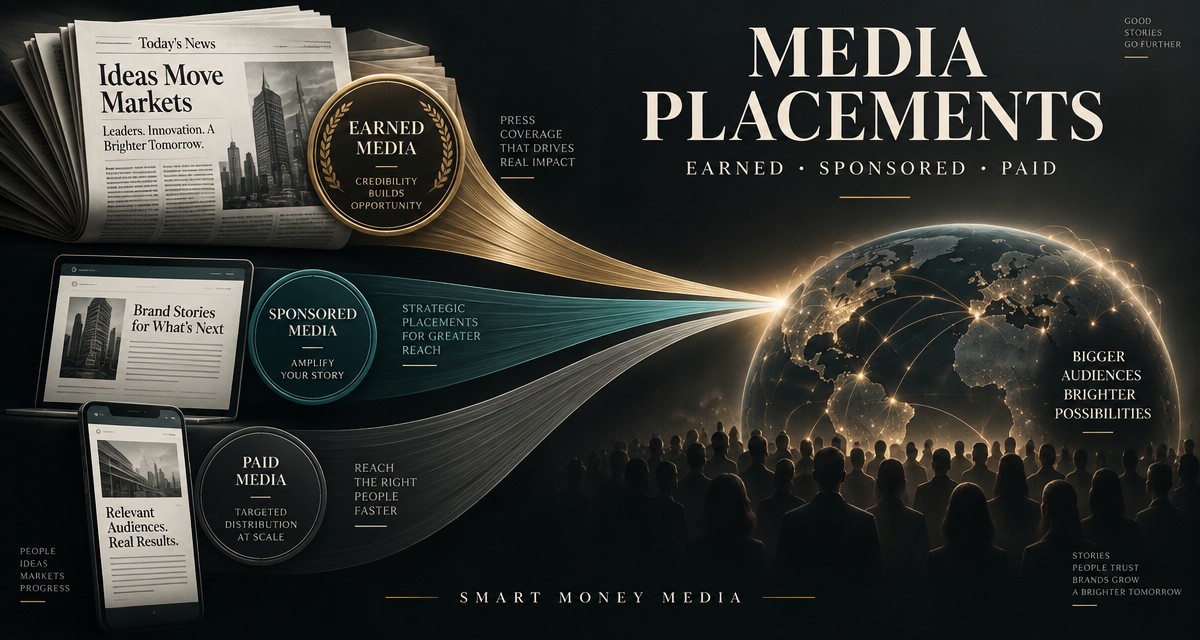
A media placement is a brand mention or feature secured inside a third-party publication, podcast, or broadcast — earned when an editor chooses to cover you, paid when you buy the slot, and sponsored when you pay but the outlet discloses it. A first earned placement typically takes months of relationship and story building, not days. Those definitions are the easy part. What follows is what buyers actually need before they spend: what each placement type really costs, how to tell a legitimate outlet from a pay-to-play network, the pitch structure that gets a reply, how to compare PR firms on placement results and earned media value instead of promises, and how to measure whether coverage moved anything.
This comprehensive guide explores the world of media placements with a clear-eyed look at what they cost, how to win them, and the honest difference between paid, earned, shared, and owned media. You'll learn how to craft a winning pitch, build a media kit, measure ROI, and decide when to invest in earned coverage versus when paid amplification is the smarter play.
What Are Media Placements?
Media placements are strategically secured brand mentions, features, or interviews in external media outlets that are earned through public relations efforts. Unlike paid advertising, these placements position a brand or its leaders as authoritative voices in their industry and can include online articles, TV segments, or podcast interviews.
The scope of media placements today has expanded far beyond traditional newspapers. Now, it includes guest posts on industry blogs, citations in viral social media, or CEO features on top podcasts. These modern placements are powerful third-party endorsements that serve as a testament to a brand's credibility and expertise.
Think of earned media placements as digital word-of-mouth marketing on a massive scale. They are the result of a concerted PR strategy focused on building relationships with journalists and influencers by offering them compelling stories and expert insights their audience will value.
When a reputable source features your brand, it transfers its own authority and trust to you. This is a core concept for building brand credibility, reinforcing executive reputation in the AI answer era, and validating your expertise in the market.
📊 Put a number on your next placement
Use our free Earned Media ROI Calculator to estimate EMV, pipeline revenue, cost per lead, and total ROI from earned, paid editorial, or blended campaigns.
Key Takeaway: Media placements are the most authentic form of brand promotion, leveraging third-party credibility to build trust and authority in a way that paid advertising cannot.
With global ad spend projected to hit $1.16 trillion, the digital landscape is noisy. Cutting through this requires a strategy that prioritizes authenticity, not just a large budget. High-quality media placements are a game-changer for businesses focused on long-term reputation management and market position.
What are the Four Types of Media Placements in the PESO Model?
The PESO model is a comprehensive framework that categorizes media efforts into four types: Paid, Earned, Shared, and Owned. A truly effective digital authority strategy integrates all four types for maximum impact.
Paid media is any media exposure you pay for directly. It includes traditional advertising like TV commercials and print ads, plus digital advertising like pay-per-click (PPC), social media ads, and sponsored content.
While it offers control and scalability, its effectiveness can be limited by ad-blockers and consumer skepticism. Social media advertising remains a powerhouse, with global spend expected to reach $276.72 billion by 2025, according to data cited by Wix.com.
Earned media is the press coverage you "earn" through merit. As the holy grail of PR, it includes placements like news articles and expert interviews. Because it comes from an objective third-party, earned media is highly credible and a primary driver for building brand trust.
Shared media refers to content shared across social media platforms. It involves engaging your community, reposting user-generated content, and fostering conversations. While it can be influenced by paid and earned media, it thrives on authentic engagement.
Owned media is any content or platform your brand controls. This includes your website, blog, and email newsletters. Owned media is the foundation of your digital presence, providing a platform to showcase your expertise and house zero-click marketing content.
A well-optimized blog, for example, can be a powerful tool for securing earned media by demonstrating your thought leadership, as discussed in How to Use Semantic SEO for Brand Authority Building.
| Media Type | Definition | Examples | Key Benefit |
|---|---|---|---|
| Paid | Media you pay for directly. | PPC, Social Media Ads, Sponsored Content | Control & Scalability |
| Earned | Third-party coverage you secure through PR. | News articles, Interviews, Reviews | Credibility & Trust |
| Shared | Content amplified via social networks. | User-Generated Content, Viral Campaigns | Engagement & Reach |
| Owned | Content channels you control. | Website, Blog, Email Newsletter | Authority & Foundation |
How to Craft the Perfect Media Pitch in 6 Steps
A media pitch is an email you send to a journalist or editor to propose a story idea. A great pitch is a blend of art and science, requiring a concise, compelling, and relevant message that respects the journalist's audience.
With reporters receiving hundreds of pitches daily, a structured approach is essential to stand out and consistently earn media coverage.
Step 1: Research the Publication and the Journalist
Before writing, invest 15-20 minutes studying the outlet and the specific reporter. Read their last 5-10 articles, noting their beat, preferred angles, and writing tone. Subscribing to their newsletter or following them on social media is also a valuable step.
This foundational research is what separates a personalized, effective pitch from spam. It is often the single biggest predictor of getting a positive response from a journalist.
Step 2: Identify a Newsworthy, Timely Angle
Journalists look for stories their readers will find engaging and shareable, not product announcements. Frame your pitch around a proven angle that provides clear value, such as offering exclusive new data or expert commentary on a trending story.
Your angle must be timely and connected to current events to capture a reporter's interest. Other strong approaches include a compelling human-interest narrative or a contrarian take on conventional industry wisdom.
Step 3: Write a Subject Line That Earns the Open
A subject line often determines if a pitch is read or deleted. Keep yours under 60 characters and lead with a compelling hook rather than your company name. Avoid generic phrases like "Story idea" or "Press release."
Strong examples include "New data: 69% of B2B searches are now zero-click" or "Exclusive: How [trend] is reshaping [industry]." It is wise to test variations to see what resonates best with journalists on a specific beat.
Step 4: Personalize the Opening and Lead With Value
Start your email with a specific reference to one of the journalist's recent articles. This should establish a genuine connection between their work and your pitch, not just offer empty flattery.
Immediately deliver the story's value by explaining what is new, why it matters now, and why their audience will care. Save your corporate background for the boilerplate at the end of the email.
Step 5: Make the Reporter's Job Easy
Provide everything a journalist needs to cover the story in your initial pitch. This includes a one-sentence summary, key data points or quotes, links to supporting research, and an offer for an exclusive interview with a named expert.
Also include high-resolution images or B-roll where relevant. The easier you make their job, the more likely you are to get a quick "yes." This value-first principle is similar to how you would write content for zero-click success.
Step 6: Follow Up Once, Then Move On
If you do not receive a response in 5-7 business days, send one polite follow-up. This message should be brief and add new value, like a fresh data point or a related story angle.
If you still get no reply, move on to avoid pestering the journalist. A respectful, professional approach protects the relationship for future pitches and is crucial for building trust.
The primary goal is not a single placement but a long-term relationship that compounds your earned media authority. Poor outreach can create reputational risks, similar to the hidden impact of negative reviews.
How Much Do Media Placements Cost? An Honest Breakdown
True earned media placements have no per-placement price because they are not for sale. What you are paying for is the strategy, relationships, time, and content production that create the conditions for editors to choose to cover you.
Reputable agencies do not and cannot guarantee specific outlets at specific prices. Doing so is either a paid sponsorship in disguise or a sign of a low-quality "pay-to-play" placement that confers no real authority.
Key Takeaway: If a vendor offers you "guaranteed Forbes coverage for $X," you are buying paid sponsored content disguised as press, not earned media. Reputable agencies sell strategy, time, and relationships — not outlet promises.
What you are actually paying for
A legitimate PR engagement bills against four cost drivers:
- Strategy and positioning — defining the narrative, message architecture, and beat-by-beat targeting plan.
- Relationship capital — established trust with specific journalists in your category, built over years.
- Content production — pitches, press releases, founder bylines, data studies, and supporting assets.
- Outreach and placement management — the active work of pitching, follow-up, interview prep, fact-checking, and post-publication amplification.
What different engagement models actually charge
The 2026 market has consolidated into three rough engagement models. Pricing varies dramatically by agency tenure, founder track record, and category demand — these are illustrative ranges, not quotes:
| Engagement model | What's included | Best fit |
|---|---|---|
| Project-based campaign | One launch, funding announcement, or product moment with 6-12 weeks of focused outreach | Pre-revenue startups with one major news moment |
| Monthly retainer | Ongoing pitching, founder thought leadership, reactive press, and crisis support | Growth-stage companies with continuous news flow |
| Fractional / authority buildout | Hybrid of strategy, content, and earned-media work focused on category leadership over 90+ days | Founders building personal + company brand together — see our Authority Buildout program |
For specific tier ranges aligned to your stage and category, the budget tier dropdown on our PR & Media intake form will pre-qualify your fit before a human conversation. We do not publish exact dollar quotes outside that intake form because real pricing depends on category competition, news flow, and the depth of relationship work required.
The hidden cost almost no one talks about
The biggest cost of bad PR is not the agency invoice — it's the opportunity cost of months spent pitching the wrong story to the wrong reporters.
A founder who burns six months on undifferentiated outreach to land two B-tier placements has spent more in time and credibility than a founder who paid 3x the retainer for one Tier-1 placement that a Series A investor actually saw. Cheap PR is almost always the most expensive PR.
What are the Differences Between Paid, Earned, and Sponsored Placements?
Understanding the difference between paid, earned, and sponsored media is crucial for distinguishing between genuine credibility and simple advertising. The lines have become intentionally blurred, a confusion exploited by both sellers and buyers. Knowing the real distinction helps you invest in true authority rather than just purchasing visibility.
Earned media (the gold standard)
An earned placement is editorial coverage chosen by a journalist on the merits of the story, with no payment exchanged for the placement itself. The brand has no control over the angle, headline, or framing.
This is what carries E-E-A-T weight, drives LLM citations, and signals real authority to investors and customers. Earned media is the slowest, hardest, and most defensible form of coverage.
Paid media (advertising)
A paid placement is straightforward advertising — a banner ad, sponsored newsletter slot, or social media ad — clearly labeled as advertising and visually distinct from editorial content. It buys reach and message control but confers near-zero credibility. Useful for amplification, useless for authority.
Sponsored / branded content (the gray zone)
A sponsored placement is a hybrid: the publication produces (or accepts) editorial-style content paid for by the brand, labeled with disclosure language like "Paid Post," "BrandVoice," "Partner Content," or "Sponsored." The reader sees something that looks like an article.
Some of these are produced by quality publishers with editorial standards; many are pay-to-play schemes from contributor networks where the brand essentially writes its own coverage.
Key Takeaway: If a journalist with a real byline chose to write about you with no money changing hands, that's earned. Everything else — Forbes BrandVoice, "as seen on" contributor posts, sponsored articles, and most "guaranteed placement" packages — is paid or sponsored, and it should be valued accordingly.
The honest comparison table
| Type | Who controls the message | Authority signal to LLMs and Google | Investor / customer credibility |
|---|---|---|---|
| Earned | The journalist | Strong — counts as third-party validation | Highest — verifiable on-the-record reporting |
| Sponsored (top-tier publisher) | The brand, with light editorial review | Weak to moderate — algorithms increasingly discount | Moderate — can be vetted by sophisticated readers |
| Sponsored (contributor / pay-to-play) | The brand, fully | Near zero — often actively penalized | Low to negative — sophisticated buyers spot it instantly |
| Paid (advertising) | The brand | None | None — clearly understood as marketing |
When sponsored makes sense (and when it doesn't)
Sponsored content from top-tier publishers (e.g., a real Wall Street Journal Custom Content piece) can make sense for top-of-funnel awareness, recruiting, or category education. This is best when you control the message and the goal is reach, not credibility.
It does not make sense as a substitute for earned coverage when raising capital or building LLM authority. The "as seen on Forbes / Entrepreneur / Inc." badges most coaches sell are sponsored placements; sophisticated investors and reporters know the difference at a glance, and using them as a credibility signal often actively damages the brand.
The right play is layered: earn the foundation, paid-amplify what you've earned, and use sponsored content surgically when reach matters more than authority. For the broader strategic context, see our PR strategy guide and brand credibility guide.
What Should Be in Your Media Kit and Digital Asset Library?
A media kit, also known as a press kit, is a digital package of assets and information created to make it as easy as possible for journalists and publishers to write about your brand accurately. A well-crafted media kit is a critical tool in your PR arsenal.
When a journalist is on a tight deadline, the last thing they want to do is hunt for your company logo or your CEO's bio. A comprehensive media kit removes this friction and demonstrates your professionalism. It should be easily accessible on your website, typically via a "Press" or "Newsroom" link in your footer. This proactive approach supports your PR & Media efforts by equipping reporters with what they need, exactly when they need it.
Your media kit should include:
- Company Overview: A brief but compelling story of your company. What problem do you solve? Who do you serve? What is your mission?
- Executive Bios & Headshots: Professional biographies and high-resolution headshots of key leaders and designated spokespeople.
- Logos and Brand Guidelines: High-resolution versions of your logo (in various formats like .PNG and .SVG) and a simple style guide for its use.
- Fact Sheet: A one-page summary of key company facts, such as founding date, number of employees, key milestones, and notable achievements.
- Previous Press Coverage: Links to or quotes from previous high-profile media placements. This provides social proof and shows you are a credible source.
- Contact Information: Clearly state the best way for media to get in touch with your PR team or designated contact person.
Key Takeaway: A professional and comprehensive media kit removes friction for journalists, increasing your chances of securing accurate and timely press coverage.
In 2026, your digital assets extend beyond the traditional media kit. Consider creating a library of B-roll video footage, high-quality product images, and infographics. As video ad spending is projected to surpass $236 billion in 2026, according to HubSpot, having ready-to-use video assets can make you a far more attractive source for digital-first publications.
Who are the Big 4 advertising agencies?
The world of media buying and planning is dominated by a few major holding companies, often called the "Big 4." Understanding these players provides context for how the world's largest brands approach media strategy.
These massive firms own vast networks of advertising, marketing, and public relations agencies, giving them immense buying power, deep industry relationships, and global reach.
The traditional "Big 4" of advertising are:
- WPP: A British multinational powerhouse, WPP owns a vast portfolio of agencies, including Ogilvy, Grey, GroupM (which itself owns Mindshare, MediaCom, and Wavemaker), and Hill+Knowlton Strategies. They offer a full suite of services from advertising to PR to data consulting.
- Omnicom Group: This American-based giant owns well-known agencies like BBDO, DDB, TBWA\Chiat\Day, and OMD. Omnicom is renowned for its creative prowess and strategic brand-building capabilities.
- Publicis Groupe: A French multinational, Publicis has aggressively moved into digital and tech consulting, acquiring firms like Sapient and Epsilon. Its agency network includes Leo Burnett, Saatchi & Saatchi, and Zenith.
- Interpublic Group (IPG): Another American global provider, IPG's network includes agencies like McCann Worldgroup, FCB, MullenLowe, and Magna, its global media investment and intelligence unit.
While these giants dominate the landscape for Fortune 500 companies, they are not the only option. Many businesses find greater success and more personalized attention with specialized, independent firms like Smart Money Media. These boutique agencies often offer deeper expertise in specific niches, more agile service, and a direct line to senior talent.
They excel at building targeted, authority-building campaigns and are often better suited for executing a nuanced Authority Buildout program.
The trend towards specialized agencies is growing as brands seek partners who can navigate the complexities of digital PR, semantic SEO, and Zero Click Score optimization. While the Big 4 command massive budgets for paid media, the art of earning media placements often requires a more focused and relational approach.
How Do You Measure the ROI of Media Placements?
Quantifying the return on investment (ROI) of a media placement is done by tracking its impact on business objectives using specific metrics and tools.
While it’s not as straightforward as tracking PPC conversions, it is entirely possible to measure the impact of your media placements with the right metrics and tools.
Instead of using outdated metrics like Advertising Value Equivalency (AVE), you must focus on metrics that tie directly to business objectives. The industry has largely rejected AVE as a flawed and misleading metric, which attempts to assign a dollar value to a placement based on what it would have cost to advertise in the same space.
Key performance indicators (KPIs) for measuring media placement success include:
- Website Referral Traffic: Use Google Analytics to track how many users visit your site from links in your media placements. Look at the quality of this traffic: what is the bounce rate, time on page, and conversion rate?
- Domain Authority (DA) and Backlink Quality: Monitor your website's DA (a metric from Moz) or similar authority scores. Each placement from a high-authority site should strengthen your backlink profile, a key goal of any SEO authority program.
- Keyword Rankings: Track your rankings for target keywords. High-quality media placements and the backlinks they generate should correlate with improved search visibility over time.
- Social Media Mentions & Engagement: Measure the number of times your placement is shared and discussed on social media. This "shared media" amplification is a significant bonus. For more ideas, see our post on Zero Click Marketing Strategies for Social Media.
- Direct Conversions: In some cases, you can attribute leads and sales directly to media placements through dedicated landing pages or unique offer codes mentioned in the content. Measuring this is the focus of our guide on Measuring Zero Click Marketing ROI.
Key Takeaway: Measure the ROI of media placements by focusing on tangible business outcomes like website traffic, SEO improvements, and lead generation, not outdated vanity metrics.
According to a 2026 report from Deloitte, the emphasis in media has shifted toward "quality engagement, audience data, and speed of innovation." This aligns perfectly with a modern approach to PR measurement, where the quality of the audience reached and their subsequent actions are more important than the sheer volume of impressions. This data-driven approach is essential for proving the value of PR and securing continued investment in your online reputation management efforts.
What Are the Key Emerging Trends in Media Placements?
Emerging media placement trends are the latest shifts in how brands connect with audiences, driven by AI, retail media, and evolving digital platforms. Staying ahead of these developments in a rapidly changing landscape is crucial for maintaining a competitive edge and ensuring your message resonates.
Artificial Intelligence (AI) in PR: AI is transforming PR workflows. AI-powered tools can analyze vast amounts of data to find the most relevant journalists, predict resonant story angles, and even help draft personalized pitches. This allows PR professionals to work more efficiently and strategically.
The rise of AI-driven search also means that being cited as a source in authoritative content is more important than ever for visibility. We explore this topic in AI Search Optimization: A Guide to the Future of SEO.
Retail Media Networks (RMNs) Explode: RMNs—advertising platforms from retailers like Amazon, Walmart, and Target—are delivering incredible results. Kantar reports that RMNs deliver 1.8x better results than other digital ads, and a net 35% of marketers plan to increase their investment in 2026.
While traditionally a paid media channel, the rich first-party data from RMNs can inform earned media strategy. These networks provide deep insights into consumer behavior and purchase intent that help create more strategic content.
The Dominance of Social and Video: Social media ad spend is projected to grow 13.6% year-over-year, reaching $277 billion in 2025, according to the We Are Social Digital 2026 Report. This massive investment underscores the importance of social platforms as a primary news and content consumption channel.
Similarly, video remains king, with spending expected to hit over $236 billion in 2026. Your media strategy must target digital-native publications with strong social and video components. This is the essence of modern brand credibility building—meeting your audience where they are.
Connected TV (CTV) is another significant area of growth. AdImpact projects advertisers will spend $2.5 billion on political ads on CTV alone in the 2026 cycle. This highlights a broader trend of audiences moving to streaming. Securing placements on popular streaming shows or in CTV content represents a new frontier for earned media.
Frequently Asked Questions
Common questions about media placements.
Sources & Further Reading
If you're invisible in AI, you're losing clients right now.
See exactly how your company appears across AI, search, and investor research — and uncover the hidden gaps costing you trust and deals.
Latest Media Placements Articles
Fresh insights and tactical deep-dives published in the media placements cluster.
How to Write a Pitch Email to a Journalist (+ Templates)
Securing top-tier press coverage requires mastering how to write a pitch email to a journalist. Learn the proven anatomy, templates, and strategic cadence.
PR Measurement: The Definitive Blueprint for Brands
Stop relying on vanity metrics. Learn how modern PR measurement connects earned media and brand visibility directly to pipeline and business outcomes.
Media Relations Strategy: Proven Guide
Struggling to secure meaningful press coverage? A modern media relations strategy bridges the gap between editorial visibility and search engine authority.
Digital PR Agency: What It Does and How to Pick One
Most brands remain invisible to search engines and AI assistants. A digital PR agency turns your best editorial placements into verifiable search authority.
Tracking Branded Search Lift from Earned Media Coverage
Stop guessing if your PR strategy works. Tracking branded search lift from earned media coverage isolates exactly how publications drive real audience demand.
How to Calculate Equivalent CPM for B2B PR Placements
Struggling to track media ROI? Discover our framework for how to calculate equivalent CPM for B2B PR placements and prove editorial value to the executive team.