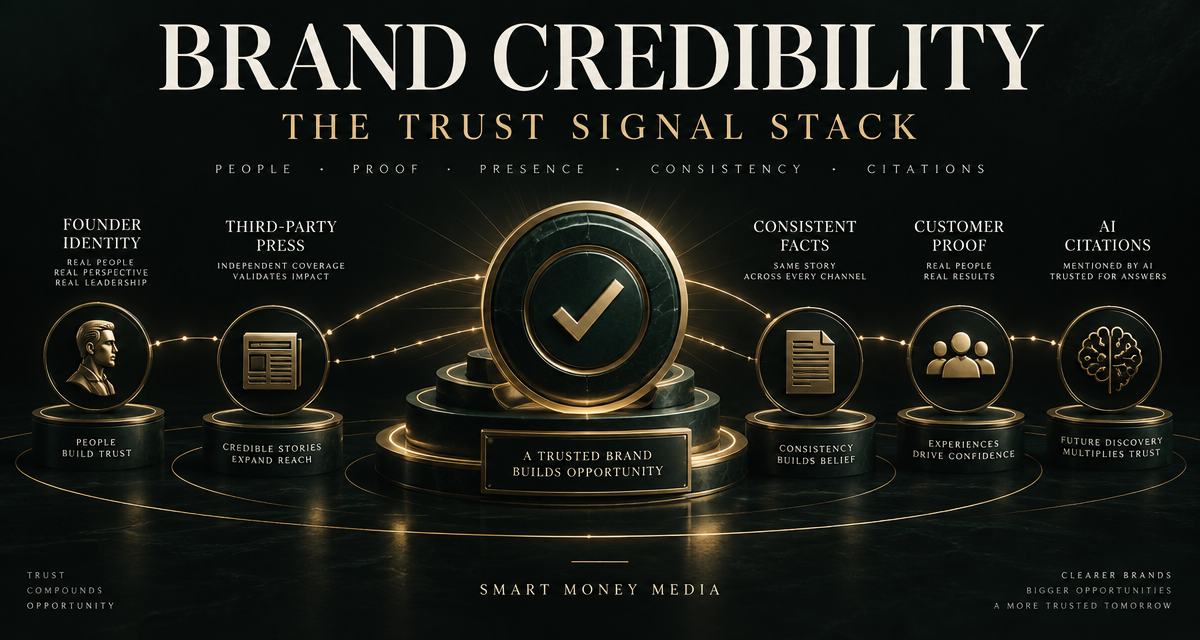
Brand Credibility: The Founder & Company Trust Playbook
Brand credibility is the verifiable, third-party trust your company and founders have earned across customers, investors, journalists, and AI answer engines — and in a market where ChatGPT, Perplexity, Gemini, and Google AI Overviews now mediate buying decisions, it is the most valuable asset on your balance sheet. For founders specifically, personal credibility is now inseparable from company credibility — investors, customers, and journalists all vet the human before they vet the brand. A significant 'trust gap' exists between how trusted companies believe they are and what consumers actually report, and closing it requires both corporate and founder-level work.
This guide provides a comprehensive framework for building, measuring, and sustaining brand credibility — including the founder-credibility playbook that drives investor and enterprise-buyer confidence, and the AI citation signals that decide whether ChatGPT, Perplexity, and Gemini mention you in buyer conversations. We unpack the core components of trust, give actionable strategies for enhancing brand authority, and explain how digital PR and reputation management compound it.
What is Brand Credibility and Why is it Your Most Valuable Asset?
Brand credibility is the perceived trustworthiness and expertise of your company in the eyes of the public. It’s the believability of your brand’s promises and the sum of all experiences a customer has with your products, people, and messaging.
A credible brand is seen as an honest, reliable, and authoritative figure in its industry.
In today's digital landscape, where consumers are bombarded with thousands of marketing messages daily, credibility cuts through the noise. It’s what differentiates a trusted advisor from just another seller. According to a 2026 report, a staggering 90% of consumers make purchases from brands they trust, making credibility a direct driver of revenue.
However, a dangerous perception gap has emerged. A 2026 PwC survey revealed that while 79% of B2C leaders believe customers trust their brand, only 52% of consumers agree.
This chasm highlights a critical disconnect where businesses overestimate their standing and underestimate the work needed to earn genuine trust. Closing this gap isn't just a PR exercise; it's a strategic imperative for survival and growth in the modern economy. For the founder- and CEO-specific layer of this work — how individual executives get cited (or misrepresented) inside ChatGPT, Gemini, and Perplexity — see our Executive Reputation in the AI Answer Era playbook.
What Are the 5 Core Components of Credibility?
Credibility is the quality of being trusted and believed in, built upon five distinct and measurable components. Understanding these pillars allows you to diagnose weaknesses and strategically build a more believable brand, and they are different from brand identity concepts like the '5 C's of branding.'
- Trustworthiness: This is the foundation. It’s the belief that your brand is honest, transparent, and has its customers' best interests at heart. It's about acting with integrity, even when no one is watching.
- Expertise: Your brand must be perceived as knowledgeable and skilled in its field. This is achieved through high-quality content, insightful analysis, and a deep understanding of your industry and customers. It’s about being a genuine authority, not just a participant.
- Authenticity: In a world of polished corporate-speak, authenticity resonates deeply. 86% of consumers say authenticity influences which brands they support. This means having a consistent brand personality and communicating in a human, relatable way.
- Reliability: This is about consistency in action. A reliable brand dependably delivers on its promises, whether it's product quality, customer service, or shipping times. Every interaction should reinforce the expectation of quality and dependability.
- Transparency: Openness about your business practices, pricing, and even mistakes is crucial. According to 2025 UK trends, visible certifications and transparent practices can boost trust by 25%. This willingness to be vulnerable and honest builds immense credibility.
By focusing on these five components, you move from hoping for credibility to actively engineering it. A weakness in one area can undermine the others, making a holistic approach essential. Ready to build an unshakeable reputation? Explore our Authority Buildout service.
Why is the 'Trust Gap' a Reality Check for Modern Brands?
The 'Trust Gap' is the widening chasm between how much brands think consumers trust them and the actual trust consumers report. This isn't just a statistical anomaly; PwC's 2026 data shows B2C executives claim an 82% consumer trust rate, while only 49% of consumers concur.
This is a flashing red light for any business that relies on customer loyalty.
This gap is fueled by several factors. Decades of over-the-top marketing claims have left consumers jaded. The rise of misinformation and the ease with which negative experiences can be shared globally on social media have created a climate of hyper-skepticism. In this environment, trust is not given; it is painstakingly earned and easily lost.
Key Takeaway: The 'Trust Gap' is the dangerous space between your brand's perceived credibility and actual consumer trust. Closing it requires radical transparency and a commitment to action over words.
Cultural relevance also plays a massive role in bridging this divide. A 2026 Kantar study found that 73% of consumers would trust a brand more if it authentically reflects today’s culture. Brands that do this well see a 27% higher trust score.
This demonstrates that credibility is not just about what you sell, but what you stand for and how well you understand the world your customers live in. Ignoring this gap is a direct threat to your bottom line and market position.
How to Build Brand Credibility From the Ground Up in 5 Steps
Building brand credibility is the process of earning trust from your audience and industry through consistent, transparent, and value-driven actions. This effort is a marathon, not a sprint, requiring a deliberate, multi-channel strategy that touches every part of your business.
The following five-step framework provides an actionable plan you can start executing this quarter.
Step 1: Prioritize Radical Transparency
Start by being unflinchingly honest on every public-facing surface. Publish your pricing clearly, admit when your product has limitations, and share how your company lives up to its stated values.
Proactively addressing potential customer skepticism disarms it and positions you as a trusted advisor, not just another seller. This transparency is a core principle behind effective Zero-Click Marketing, where you provide immense value upfront without demanding a click.
Step 2: Deliver Overwhelming Proof in Every Claim
Avoid making unsubstantiated claims. Instead, use detailed case studies with named clients, video testimonials, third-party validation from analysts, and authentic user-generated content to back up your statements.
Replace generic adjectives like "industry-leading" with specific numbers and verifiable proof points. The more evidence you can provide, the more believable your marketing becomes. For a deeper dive into managing this proof, see our guide to reputation management.
Step 3: Consistently Publish Authoritative Content
Become the go-to resource in your niche by creating high-value content that answers your audience's toughest questions. Commit to publishing 2-4 in-depth pieces per month, such as blog posts, white papers, or original research.
Each piece must demonstrate first-hand expertise, not just regurgitate what is already online. Learn how to use semantic SEO for brand authority building to supercharge this effort.
Step 4: Leverage Third-Party Endorsements and Earned Media
Positive mentions in reputable media outlets are credibility gold. A well-executed Digital PR strategy can secure placements in trusted publications, which act as powerful endorsements that self-promotion cannot replicate.
As TopRank Marketing found, 64% of B2B marketers report stronger brand credibility when working with trusted influencers. Aim for one Tier-1 placement per quarter. Explore how our PR & Media services can help.
Step 5: Operationalize Reputation Management
Unmanaged reviews and social media complaints can quickly destroy hard-won credibility. Implement brand monitoring across Google, G2, Trustpilot, social platforms, and industry forums to stay informed.
Respond to every review, positive and negative, within 48 hours, and route serious issues to a senior team member. Systematically request reviews from satisfied customers to build a steady stream of positive social proof. This is the credibility insurance policy that protects your brand.
Brand Credibility Examples: What Credible Brands Do Differently
Credible brands do not claim trust — they leave verifiable evidence in the places buyers and AI engines actually check. The difference between a brand that reads as credible and one that reads as marketing is almost always the density of third-party, checkable proof.
Four patterns show up repeatedly in brands that convert on credibility alone:
- They publish numbers a skeptic can verify. Named case studies with real figures beat "industry-leading" every time, because a prospect can check the client, the timeline, and the outcome.
- They are described consistently everywhere. The same positioning language appears on the site, LinkedIn, Crunchbase, review profiles, and press coverage. Inconsistency is what makes an AI engine hedge — or describe you wrong.
- They are cited, not just mentioned. Earned editorial coverage and original research get referenced by other writers, which is what turns a brand into a reference source rather than a search result.
- They answer hard questions in public. Pricing, limitations, and competitor comparisons published openly disarm the skepticism that kills late-stage deals.
How AI answer engines judge brand credibility
ChatGPT, Perplexity, Gemini, and Google AI Overviews do not have a trust score for your company. They assemble an answer from the sources they can find and corroborate. That means credibility in AI search is a function of reference authority — how often independent, crawlable sources describe you in consistent, factual terms.
Practically, this reorders the work: a single reported feature in a publication AI engines cite frequently does more for your credibility than a quarter of self-published content. This is the same logic behind earned media value — the value sits in the source, not the mention.
Key Takeaway: Brand credibility is now measured by corroboration. If three independent sources say the same true thing about you, buyers and AI engines both believe it. If only your website says it, neither does.
Want a read on how AI engines currently describe your brand? Run the free AI visibility audit — it shows which sources are shaping your answer, and where the gaps are. For ongoing corporate-level trust work, see reputation management.
What is Founder Credibility and Why Does It Matter?
Founder credibility reflects a leader's verifiable authority, which is now inseparable from their company's overall credibility. In today's landscape, investors Google a founder before reading their deck, and enterprise buyers search a CEO’s name before taking a meeting. Journalists now vet the person behind the company before considering coverage.
A thin or unverifiable digital footprint signals risk, regardless of business strength. Conversely, a credible personal brand can help an early-stage company overcome gaps in revenue, product maturity, or market recognition that would otherwise be fatal.
Key Takeaway: Founder credibility is now a primary diligence input — for investors, customers, journalists, and AI answer engines. Building it is not vanity; it is corporate infrastructure.
The four pillars of founder credibility
- Verifiable track record — A complete, accurate digital footprint: LinkedIn with full work history, Crunchbase founder profile, Wikipedia or Wikidata entry where eligible, and a personal site that consolidates everything. Gaps and inconsistencies kill credibility faster than thin content.
- Published point of view — A defensible thesis on your category, published consistently across owned channels (LinkedIn long-form, Substack, personal site essays) and earned channels (bylined articles, podcast appearances, conference keynotes). The point of view must be specific enough to be controversial.
- Third-party validation — Tier-1 media coverage that quotes the founder by name, podcast appearances, conference stages, board seats, and notable advisors. These are the citation surface area that LLMs and journalists pull from when verifying who you are.
- Network density — Who endorses you publicly. LinkedIn recommendations from credible operators, public co-signs from category-respected investors, and visible relationships with named industry experts. Density matters more than breadth.
Why this matters more for founders than for corporate brands
Corporate brands have a diversified reputation across teams, products, and history, but a founder's reputation is singular. A credibility deficit in one person can sink an otherwise-viable company, especially during a competitive funding round.
Conversely, a founder with a strong personal brand can secure capital and close enterprise deals on favorable terms. This isn't about vanity; it's about providing critical risk reduction for investors and customers on the other side of the table.
The founder credibility playbook
- Audit and consolidate the footprint. Fix LinkedIn, claim Crunchbase, lock down a personal domain, and ensure every public bio uses identical positioning language.
- Define and publish a defensible point of view. One thesis, repeated across formats — long-form LinkedIn posts, a Substack, podcast appearances, and bylined articles. Three core ideas, executed consistently for at least two quarters before expecting compounding inbound to follow.
- Earn three Tier-1 placements with the founder named. Not the company — the founder, quoted by name, in publications a sophisticated investor or customer would recognize.
- Build the network density layer. Six to twelve public co-signs from credible operators, secured through real relationships rather than asks-for-favors.
This is exactly the operating model behind our Authority Buildout Program, which combines founder positioning, content production, and earned-media placement into a single coordinated engagement.
For the broader context on how founder credibility plugs into company-level brand strategy, see our PR strategy guide and the SEO digital authority guide. For executives managing personal search results, AI answer surfaces, and review removal, see our Personal Reputation Management playbook. AI-category founders should also reference the AI Startup PR guide.
What Are the 3 C's of Credibility?
The three C's of credibility are competence, character, and connection, which together form a framework for building a trustworthy presence. Mastering each pillar is essential for any leader or brand aiming to establish and maintain their reputation.
Competence is the proven ability to deliver on your promises, representing the "what" of credibility. It's demonstrated through your skills, expertise, and track record. For a brand, a flawless product, insightful content, and a knowledgeable team are the baseline requirements for being a serious player in your field.
Character is the integrity, honesty, and ethical principles that define the "who" of your credibility. It is revealed by your actions, especially under pressure. By honoring commitments, being transparent, and taking responsibility, you assure stakeholders that you can be trusted, building deep psychological safety.
Connection is your ability to build rapport and show you care for your audience, which is the "how" of credibility. This is fostered through empathy, active listening, and authentic engagement. For a brand, it means understanding customer pain points and creating a sense of community.
A strong connection makes people feel seen and valued, transforming a transactional relationship into a loyal one. Without connection, even the most competent brand can feel cold and distant.
Key Takeaway: Competence gets you in the game, Character keeps you in the game, and Connection makes you the only one they want to play with. All three are essential for lasting brand credibility.
How Does Online Reputation Management Build Credibility?
Proactive online reputation management (ORM) is the practice of shaping public perception to build brand credibility and turn skeptics into advocates. Your online reputation is a direct reflection of your brand, and today, the public controls that conversation through reviews, social media comments, and forum posts.
The goal is to foster positive sentiment by monitoring conversations, addressing criticism, and amplifying positive feedback. Ignoring this can be devastating, as our research shows the hidden impact of negative reviews is often greater than businesses realize.
An effective ORM strategy for building credibility includes these key pillars:
- Monitor Everywhere: Set up alerts for your brand, products, and executives across social media, review sites (like G2, Capterra, Google Reviews), and industry forums. Knowing what is being said is the first step.
- Respond Strategically: Address negative feedback promptly and publicly. A thoughtful, empathetic response that offers a solution can win over the original critic and impress onlookers. Avoid generic, defensive replies.
- Encourage Positive Reviews: Systematically ask satisfied customers for feedback. A steady stream of recent, positive reviews is one of the strongest credibility signals you can have, so make it easy for them to post on relevant platforms.
- Showcase Social Proof: Integrate your best testimonials and case studies throughout your marketing materials. This provides tangible proof of your value and helps neutralize negative comments. Visit our hub on Online Reputation Management for Small Business for more tips.
What is the '3-7-27' Rule for Branding?
The '3-7-27' rule is a branding concept that provides a framework for making your brand memorable and building the consistency necessary for trust to form. It offers a simple yet effective model for how to stand out in a crowded marketplace.
- 3 Seconds to Make an Impression: This is your brand's first handshake. A potential customer should understand who you are and what you do within three seconds of landing on your website or seeing an ad. This requires a crystal-clear value proposition and compelling visual identity.
- 7 Minutes to Build Engagement: Once you have their initial attention, you have about seven minutes to engage them and build interest. This is where your core content—be it a blog post, a video, or a detailed product page—must deliver value and convince them to invest more time in your brand. It's your chance to prove your competence.
- 27 Touchpoints to Create a Loyal Customer: This is the long game. The rule suggests it takes, on average, 27 touchpoints to convert a prospect into a loyal customer. These touchpoints can be anything from reading a blog post, seeing a social media update, receiving an email newsletter, to hearing a mention on a podcast.
This rule underscores the importance of a multi-channel, persistent PR and marketing strategy. You cannot expect a single ad or article to build lasting credibility. Trust and loyalty are built over time, through consistent, valuable interactions across multiple platforms.
Each touchpoint is a small deposit in your brand's credibility bank. The goal is to make every deposit a positive one, reinforcing your expertise and connection with each interaction. This ultimately improves your brand's Free AI Visibility Audit by providing value at every step.
What KPIs Measure Brand Credibility and Trust?
Key Takeaway: If you can't measure it, you can't improve it. Tracking brand credibility requires moving beyond vanity metrics to focus on KPIs that reflect genuine trust and authority.
Tracking the right key performance indicators (KPIs) allows you to quantify your credibility-building efforts and identify areas for improvement. While not as simple as tracking sales, measuring brand trust is just as important for long-term growth.
| KPI Category | Metrics to Track | Why It Matters |
|---|---|---|
| Brand Sentiment | Social media sentiment analysis (Positive/Negative/Neutral mentions), Brand vs. Competitor share of voice. | Tells you how people feel about your brand in unfiltered conversations. |
| Review Scores | Average star ratings on Google, G2, Trustpilot, etc. Volume and velocity of new reviews. | Direct, quantifiable feedback on customer experience and a primary signal for new buyers. |
| Branded Search Volume | Month-over-month growth in people searching specifically for your brand name. | Indicates growing brand awareness and recall, a direct outcome of building credibility. |
| Media & Backlink Quality | Number of mentions/links from high-authority domains (e.g., major news sites, top industry blogs). | Third-party endorsements are a powerful vote of confidence. Not all links are created equal. |
| Content Engagement | Metrics like average time on page for thought leadership content, shares, and inbound links to articles. | Shows that your audience finds your content valuable and authoritative. |
You can use tools like Google Alerts, Brand24, and Semrush to track many of these metrics. For a comprehensive analysis of your brand's performance in search, consider our proprietary Free AI Visibility Audit.
By regularly reporting on these KPIs, you can prove the ROI of your credibility-building initiatives. This makes it possible to make data-driven decisions that strengthen your brand's most valuable asset.
Frequently Asked Questions
Common questions about brand credibility.
Sources & Further Reading
Still have a question about this guide?
Ask Smart Money Media — cited answers pulled from our library, grounded in this article.
If you're invisible in AI, you're losing clients right now.
See exactly how your company appears across AI, search, and investor research — and uncover the hidden gaps costing you trust and deals.
Latest Brand Credibility Articles
Fresh insights and tactical deep-dives published in the brand credibility cluster.
How to Write a Pitch Email to a Journalist (+ Templates)
Securing top-tier press coverage requires mastering how to write a pitch email to a journalist. Learn the proven anatomy, templates, and strategic cadence.
Proven B2B SaaS Thought Leadership Strategy Framework
A structured B2B SaaS thought leadership strategy framework turns generic content into a defensible POV. Learn how original research drives commercial impact.
The Modern Crisis Communication Plan: Build Your Brand
A crisis communication plan dictates how a brand responds to sudden threats. Discover the definitive framework for protecting your digital reputation and trust.
PR Measurement: The Definitive Blueprint for Brands
Stop relying on vanity metrics. Learn how modern PR measurement connects earned media and brand visibility directly to pipeline and business outcomes.
How to Build Unshakeable Brand Trust
Brand trust is the ultimate competitive advantage. Discover the behavioral psychology, actionable metrics, and third-party validation strategies required to build lasting customer loyalty and drive conversions.
Proven Personal Reputation Repair Strategies for Executives
Negative search results and AI summaries destroy executive credibility. Discover the exact frameworks and strategies required to suppress damaging content, rebuild trust, and control your digital narrative.